Three Things To Read This Week
1. Report: States Share Lessons On Building Coordinated Crisis Systems Across 911 And 988.
The Council of State Governments published some of the early learnings from a recent convening of four states—New Jersey, Utah, Virginia, and Washington—where state leaders are integrating 911 and 988 emergency response into a single, coordinated system that saves resources and reduces response times for all first responder teams, from law enforcement to mobile crisis response to fire to paramedics. The full report is worth reading for any local leader looking to successfully integrate 911 and 988, but here are some of the toplines:
Clear Dispatch Protocols And Defined Roles Improve Crisis Routing: State leaders in Washington and New Jersey reported persistent friction when crises move across systems, with “uncertainty around call transfers, liability…transportation, and decision-making authority” slowing response times and creating gaps in care. State leaders in Utah and Virginia emphasized that “clearly defined dispatch protocols were most effective when implemented alongside defined roles across agencies, shared understanding of who is responsible across each decision point, and escalation criteria to help route crises to the most appropriate response.”
Standardized Training And Shared Data Improve Outcomes: Across all four states, leaders pointed to “staffing shortages, training demands, and variation in credentialing” as the primary challenges to scaling crisis systems statewide. Utah and Washington are responding by highlighting their “investments in standardizing their training models, including regional and on-demand trainings designed to build shared expectations across systems.” Leaders also explained that “being able to rely on accurate and up-to-date crisis response data has helped many of these states better understand call outcomes, identify system gaps, and inform funding and legislative decisions.”
A Wider-Variety Of Responder Teams Are Needed: State leaders identified responder gaps, especially for crises involving “housing insecurity, substance use, or community conflict,” and others that don’t fit exactly with the responder teams that can be deployed. Expanding the variety of teams cities deploy can be a solution, giving each a specific function—mobile crisis response for mental health-related calls for service, homeless response team for calls related to homelessness, mediation response for low-level disputes between neighbors, and others. To get there, states may need to rethink definitions of crisis itself, moving beyond “narrow statutory definitions” and building “alternative dispatch and response pathways” that better reflect the crises in a given community.
Spotlight On Three Cities Already Integrating 911 And 988 Emergency Response:
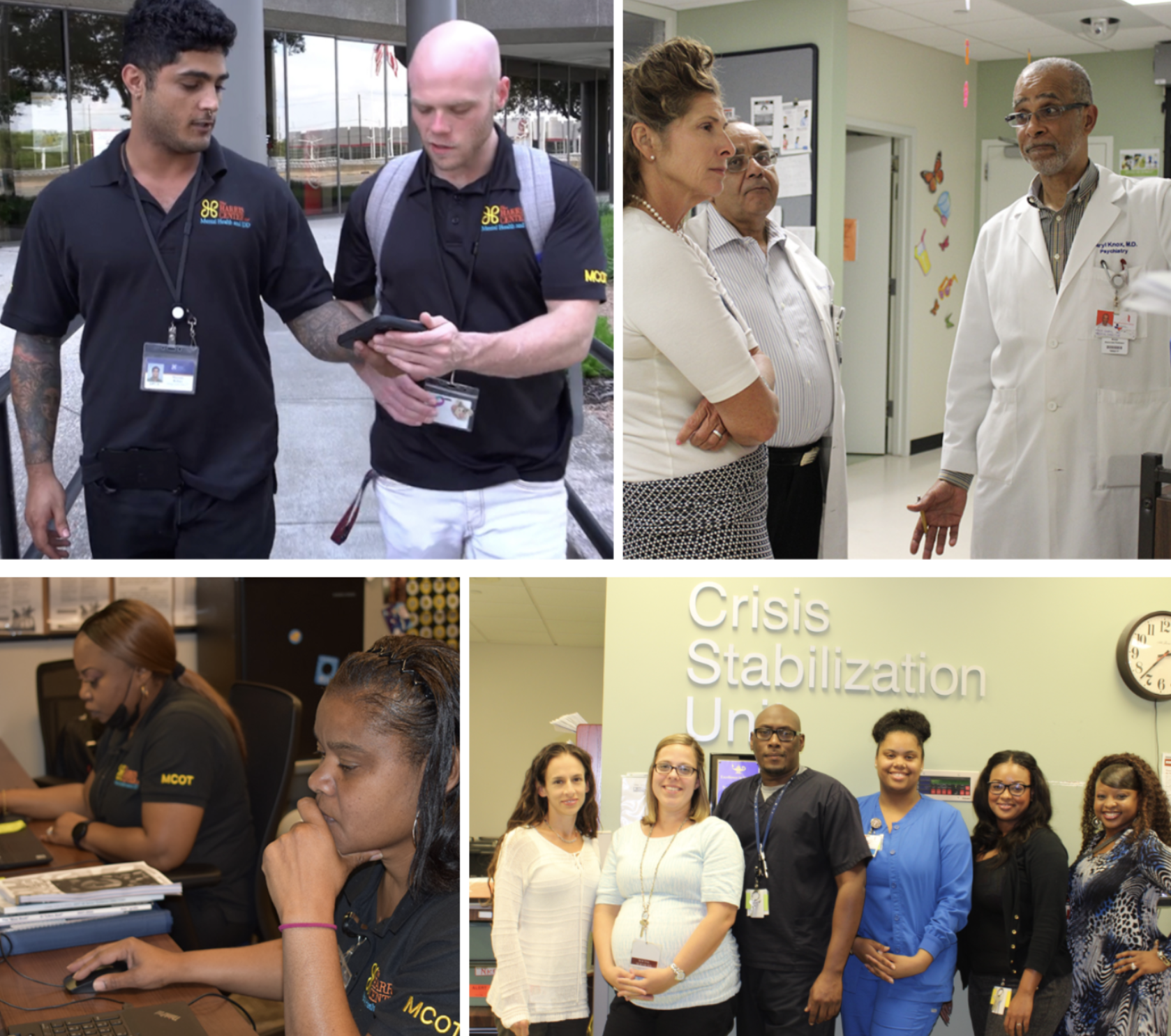
In Houston, Texas, The “911 Call Diversion Program And Rapid Response Continue To Strengthen The City’s Fourth Emergency Response.” For CrisisTalk, Stephanie Hepburn reports on the city’s “24-hour crisis call diversion program” that “is embedded within Houston’s 911 call center, providing a fourth emergency response—mental health and substance use intervention.” The program, which “dispatches mental health clinicians” to “nonviolent, non-criminal 911 calls and police department non-emergency line calls” has been in operation since 2016 and gives city leaders looking to integrate 911 and 988 a successful working model to consider.
The program is “run by the Harris Center for Mental Health and Intellectual and Developmental Disabilities” and coordinates “in real time with 911 call center partners, including the city’s police and fire departments.” When a person calls 911, “a call taker assesses the nature of the emergency and determines the response the call requires and priority type… [and] directly live transfer callers experiencing mental health or substance use concerns so long as there’s not an imminent, life-threatening risk or criminal activity.” Last year, crisis call diversion diverted 5,033 calls from 911, a 21.6% increase from 2023,” and their rapid response “resolved 84% of calls without law enforcement involvement.” The Harris Center serves as a hub for a wide variety of responder teams, and health facilities, that allows for targeted response and better outcomes for people in crisis and the teams responding, including:Mobile Crisis Outreach Team: This team provides “response services to individuals of all ages who are experiencing a mental health crisis and are unable to access services independently… until the crisis is resolved or the individual is placed in a clinically appropriate environment.”
Homeless Outreach Team: This team “engages in street outreach to the homeless community to provide outreach services and case management to individuals who are homeless and experiencing a serious behavioral illness… to reduce the number of people who are homeless and living on the streets.”
Crisis Stabilization Unit: This facility “provides inpatient stabilization for Harris County residents (ages 18+) who are experiencing an acute behavioral health crisis… psychiatrists and registered nurses provide supervision of the unit… [which is] available 24 hours/day, 365 days/year….[with patients having an] average stay [of] approximately 3-5 days.”
Psychiatric Emergency Services: This facility “provides psychiatric evaluations and initial treatment to individuals of all ages in psychiatric crises… the unit is staffed 24 hours/7 days a week by psychiatrists, psychiatric nurses, clinical social workers, licensed professional counselors, psychiatric technicians, and behavioral health specialists…”
Los Angeles County, California, “Expands Effort To Divert [911] Mental Health Crisis Calls” To Counselors At 988. For LAist, Robert Garrova reports on the county’s expansion of a “program that diverts some non-violent 911 calls for service… away from law enforcement… to 988 [crisis counselors]” to provide mental health care to people in crisis, while preserving stretched police resources for solving crimes. The expansion allows emergency calls “related to mental health crises made to the sheriff's Century Station [to] now be diverted to counselors trained on de-escalation.” The program has seen promising results where it is already in operation at the sheriff’s “Lancaster Station and at police departments in South Gate and Pomona,” so local leaders decided to expand it to a wider footprint. Local leaders explained that a similar integration effort that was piloted with the LAPD “diverted about 1,400 calls for service in 2024 alone… [with crisis] counselors able to handle 97% of those calls without law enforcement involvement.” Janice Hahn, a county supervisor and champion of the integration program in her district, explained to the news site that “connecting 911 to the mental crisis hotline, ensures that law enforcement and first responders can focus on keeping our neighborhoods safe while mental health professionals can step in to support those who need them.”
In Salt Lake City, Utah, “Innovative Dispatch Diversion Program Gives More Crisis Options.” For CSG Justice Center, Megan Hitchman highlights the city’s “model of cooperation between 911 dispatch and mental health services… [that] translates to major benefits for our community members and cost savings for our 911 and law enforcement partners.” The program developed as “law enforcement and dispatch personnel had noticed that many of their calls involved mental health needs rather than medical emergencies.” So city leaders decided to integrate 988 and 911, and “directors from law enforcement, dispatch, and Huntsman Mental Health Institute collaborated to devise a strategy to divert appropriate calls to 988 so people can get the support they need.” They decided that “law enforcement still handles calls involving immediate physical threats” and other related emergencies, while “nonemergency mental health crises… or nonviolent conflicts” could be safely diverted to 988 dispatch, instead.
“Though it’s early, the results have been promising. Amanda McNab, a clinical therapist who manages the 988 side of the team, explained that they are seeing only a “low number of cases needing re-transfer to 911” and that the volume of available calls is so high that the team is “on track to expand the collaboration [across] Utah by the end of the year.”
2. Spotlight: L.A. Metro Transit Ambassadors Launch New Division, “Headed By A Licensed Clinical Social Worker,” For “A Pinpointed Response” To Homelessness And Drug Use, Enhancing “Safety On Trains, Buses, Stations.”
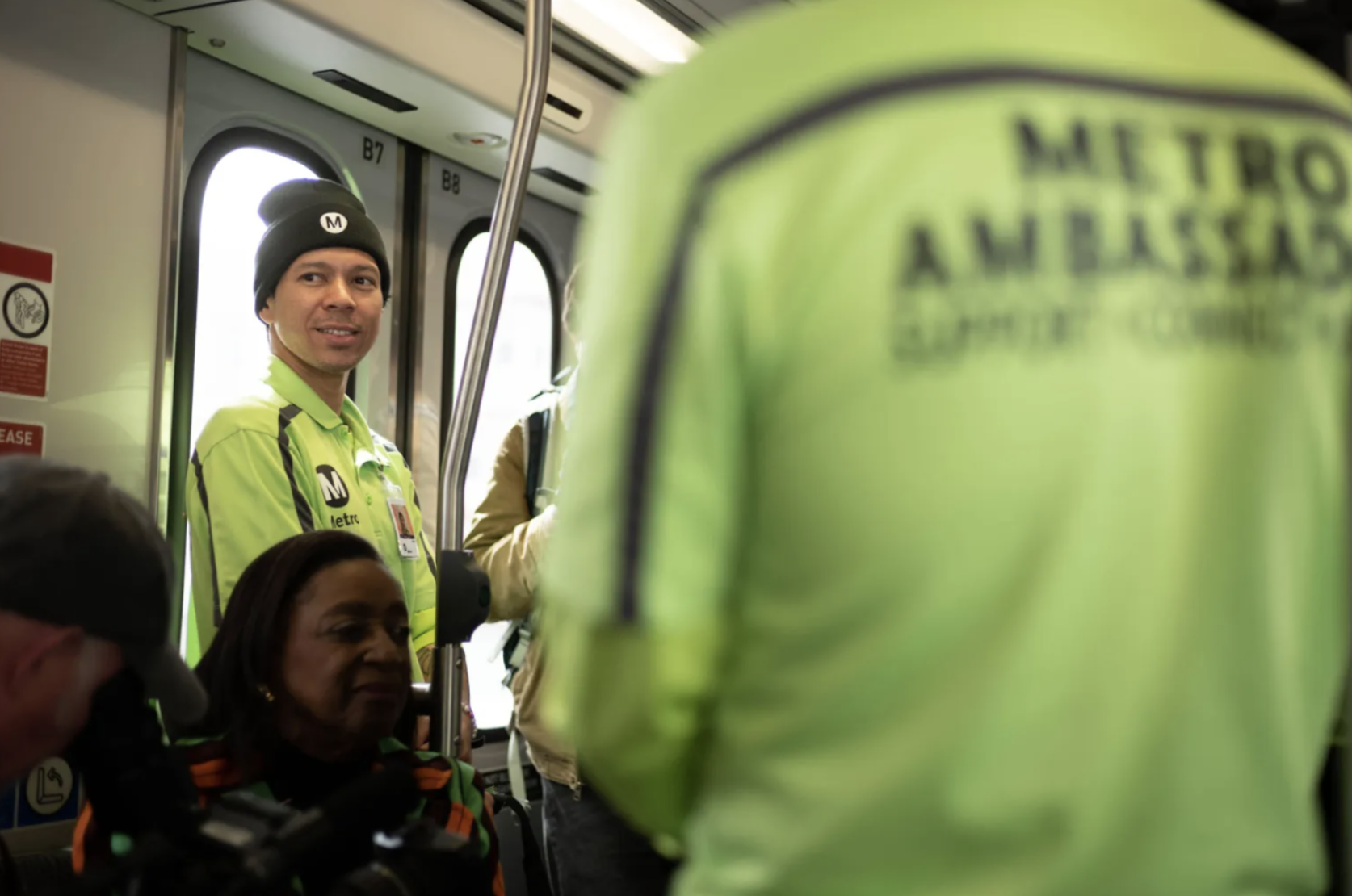
For The Daily News, Steve Scauzillo reports on the new unit launched by the L.A. Metro Transit Ambassadors, called, “Care-Based Services Division,” where “the idea is to match the call with the right kind of response, instead of the old model of always calling in armed law enforcement to every situation.” Craig Joyce, the clinician leading the team, explained to the newspaper that if a call for service comes in “and the words ‘mental health’ was part of that call, they would bring in a mental health team” now.
Just last year, county leaders expanded the Transit Ambassadors program, as Pasadena Now reported, “creating an in-house Transit Ambassador department” a move that made the Transit Ambassador team “officially now Metro employees — a milestone that is a reflection of the program’s success,” county leaders said in an announcement of the shift. Transit Ambassadors “help riders navigate the Metro system, provide assistance, connect them to resources and report issues that need to be addressed… including summoning emergency help for those customers in distress, as well as providing critical live-saving support.” Since the program first launched in 2023, the team has “helped over 645,000 people…” and saved over 300 lives. A recent UCLA study on the city’s transit ambassador program found that “the program has largely been a success,” makes riders feel safer while using public transit, and that having their “eyes on the system, helping people navigate… tell you which train to go… [the team is] deterring crime and anti-social behavior simply by being there…”
3. Clean Teams Around The Country “Empty Trash Cans, Scrub Graffiti And Deal With The City’s Human Crises.”
In St. Cloud, Minnesota, New Clean Team Focuses On “Cigarette Butts, Debris And Safety… To Make [Downtown] A Better Place. For St. Cloud Live, Trent Abrego reports on the city’s downtown clean team, which launched just six months ago, but is already seeing results. The clean team focuses on “sweeping sidewalks, picking up trash, removing snow [in the winter months]...” and removing graffiti, and as KNSI News reports, the team has been busy, having “picked up 15,000 cigarette butts, pulled over 5,200 weeds, and removed 3,500 pieces of litter since they first hit the streets.” John Torgerson, who oversees the team, explained to the newspaper: “the presence of the green shirts, green vests, and great jackets help create a [safe] environment… I haven’t heard one negative comment.”
In Worcester, Massachusetts, “Quality Of Life Team Is Cleaning Up, Helping People.” For Boston25 News, Cayle Thompson and Bob Dumas report on the city’s clean team focused on “making sure neighborhoods are not only safe but are also welcoming and thriving.” The team picks up “improperly disposed trash on city streets… mattresses and old TVs… [abandoned] shopping carts that had been dumped in a neighborhood… discarded hypodermic [needles] along popular trails”—all part of an effort to produce “a clean city that makes everyone proud.” The team, in operation for about two years, also works with the city’s homeless population, providing connection to medical care and city services. Derek Oakes, who was formerly homeless in the city, said his life began to turn around after a chance encounter with the Quality of Life team. He told the news station: “I was actually homeless two years ago and I ran into Quality of Life, and they gave me a chance on giving me a place to live, so it’s been successful. I’ve been there a year now, I just got my lease renewed. thanks again to the Quality of Life… they saved my life.”
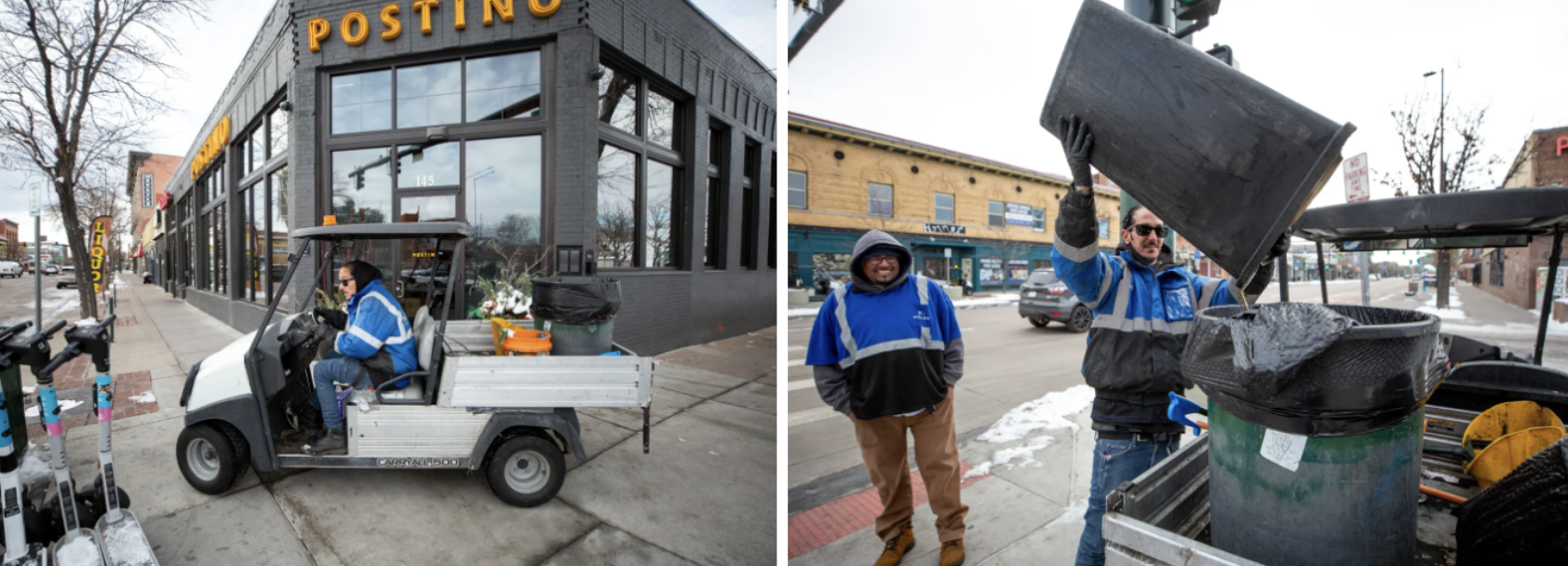
In Denver, Clean Team “Empty Trash Cans, Scrub Graffiti And Deal With The City’s Human Crises.” For Denverite, Paolo Zialcita reports on the city’s clean team, outfitted in bright blue shirts and jackets, and “armed with an arsenal of garbage bags and trash grabbers… [and] golf carts” to “clean up some of Denver’s most popular corridors.” The team is “visible, uniformed, approachable, and trained … to keep public spaces clean, cared-for, and welcoming—block by block.” What that looks like is “rapid storefront cleanups at neighborhood spots … quick litter pulls… sweeping around bus stops, refreshing cans that were in tough shape, and washing down hot spots so sidewalks felt safe and walkable again…[and] fast graffiti response when tags appear in high-visibility locations.” The team describes its role in the city’s public safety infrastructure, because “clean, bright corners feel safer… that brings more feet on the block and steadier business days… quick [cleanups] prevent bigger, costlier fixes… [and] it’s good for the corridor … builds trust with boards, owners, and neighbors.”