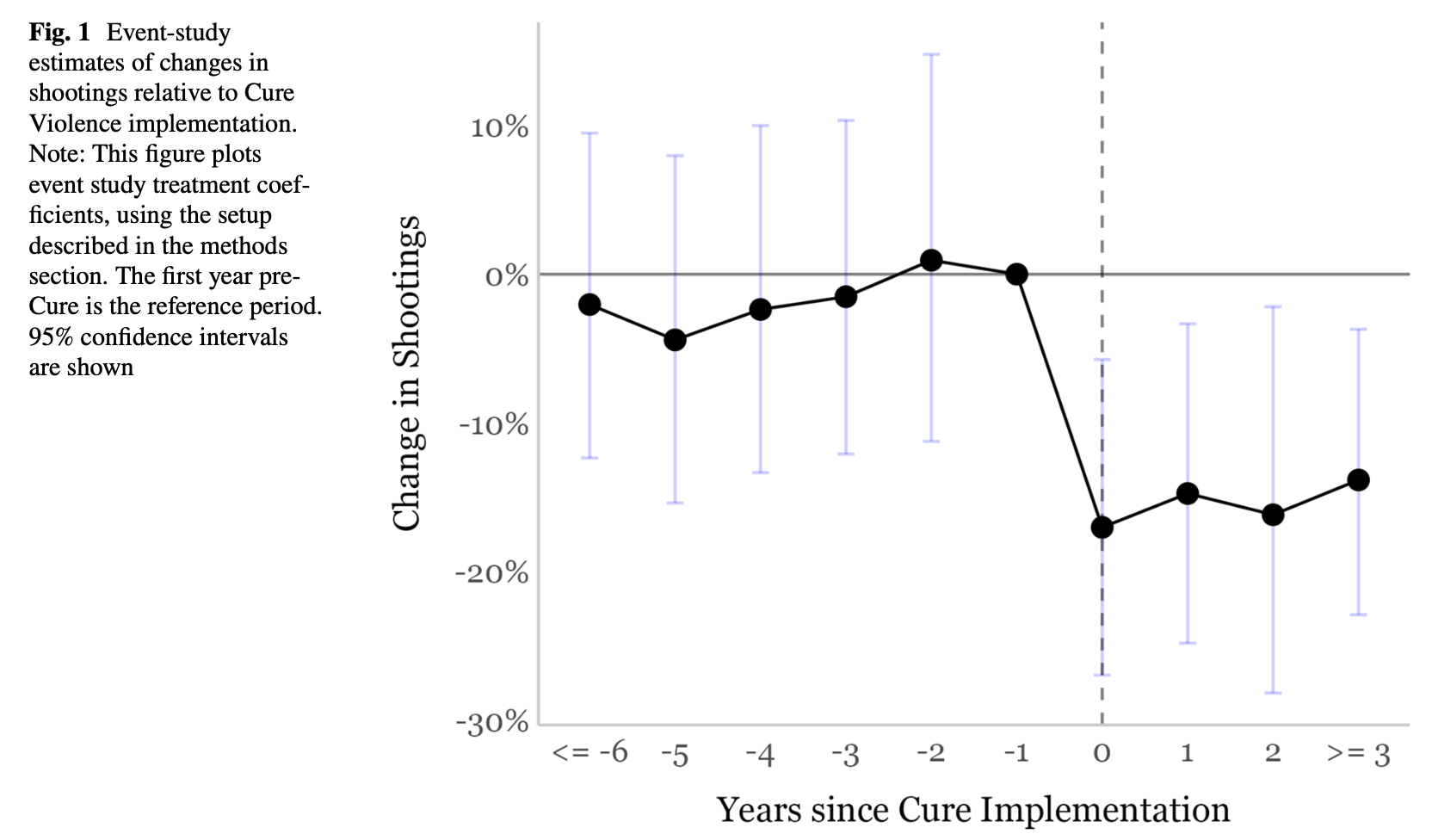
A new study published in the Journal of Urban Health from researchers with the New York City Council’s Data Science Division finds that the city’s Cure Violence community violence intervention programs were associated with a significant 14% reduction in shootings. The researchers analyzed NYPD shooting data from 2006 to 2023, using a natural experiment created by the staggered rollout of programs across 28 police precincts, compared with 48 precincts without programs, through difference-in-differences and event-study models. The researchers conclude that Cure Violence “represents a scalable and cost-effective strategy that merits continued investment and replication in comparable jurisdictions nationwide.”
- Credible Messengers Mediate Conflicts, Connect High-Risk Residents To Services. Programs employ “outreach workers” and “violence interrupters,” many with “prior gang or justice-system involvement, allowing them to function as ‘credible messengers.’” Workers “attempt to mediate and de-escalate disputes before they escalate into shootings” and “connect participants with services such as employment support, substance-use treatment, and housing assistance.” “To maintain trust with participants, Cure staff operate independently of law enforcement.”
- Shootings Fall 17% At Launch, With Significant Reductions Three Years Later. “In the year of Cure implementation, the treated precincts experienced a significant 17% … reduction in the gap in shootings between Cure and control precincts.” The researchers also found a “significant 15% … reduction in shootings 1 year post the implementation of Cure” and a “significant 16% … reduction in shootings 2 years post the implementation of Cure.” “Even … 3 or more years post-treatment, there is a 14% … reduction in shootings.”
- An Estimated 1,296 Shootings Avoided, $6.50 In Benefits For Every $1 Spent. “Our estimate implies that, on average, NYC would have seen 108 or 7.6% more shootings per year between 2012 and 2023 in the absence of Cure.” Over those years, “this adds up to 1296 shootings avoided, which translates to $2.9 billion in social welfare gained.” With “the total cost of [the city’s crisis management system] from fiscal year (FY) 2013 to 2023 … about $450 million… the benefit-cost ratio was approximately 6.5:1, implying substantial social gains.”
Cities With CVI Programs Seeing Promising Results, Across The Country:
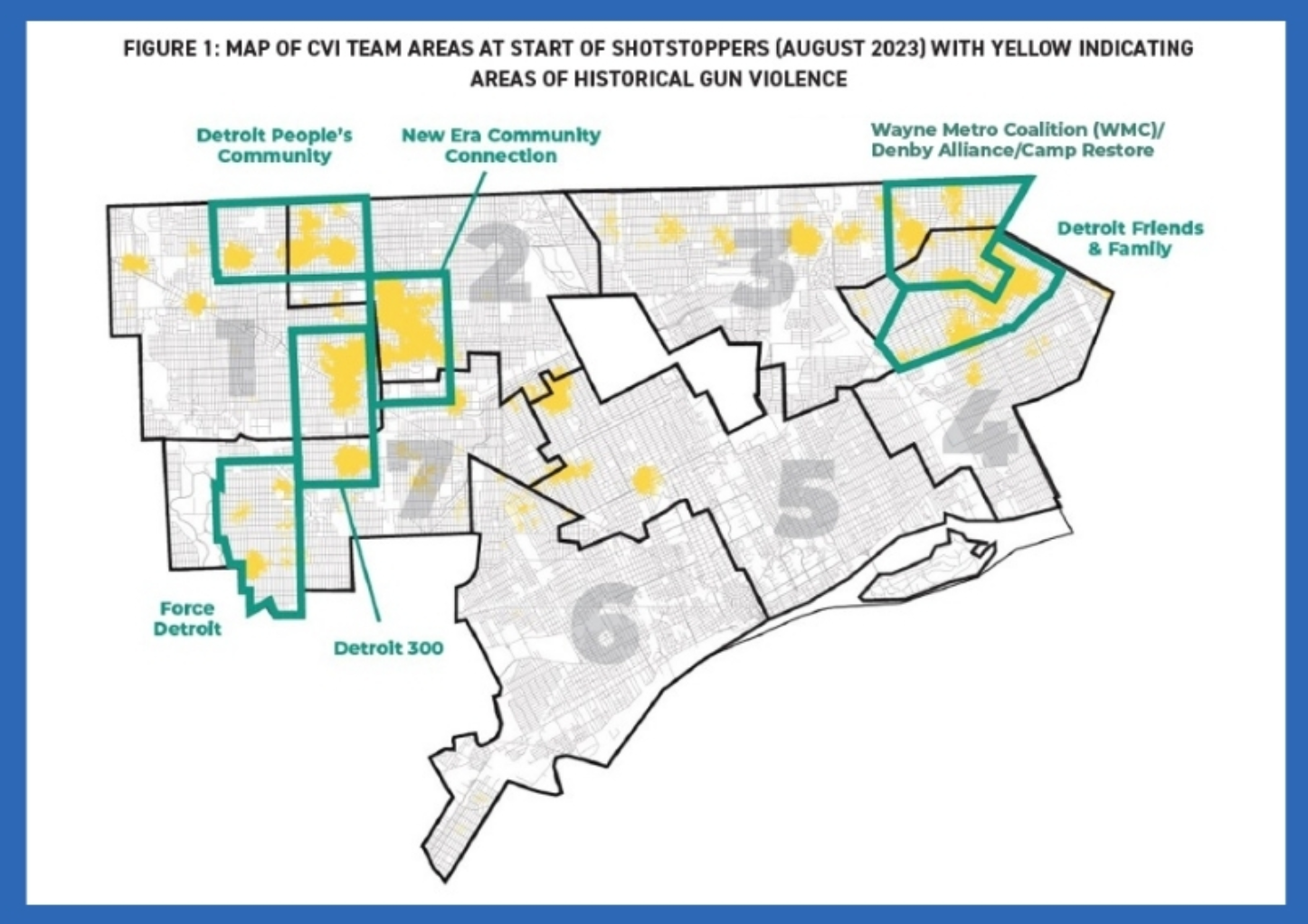
- In Detroit, Community Violence Intervention Zones See Homicides Fall 33% And Shootings 38%, Outpacing Rest Of City. The University of Michigan’s Poverty Solutions issued a recent report that found in the second year of Detroit’s ShotStoppers community violence intervention program, “the CVI zones outpaced the rest of the city with an overall decrease in their homicide victimizations of 33% and non-fatal shooting victimizations of 38% since the prior year, compared to the rest of the city’s reductions of 12% and 26%, respectively.” The city “provides ongoing and performance-based grants to community-based organizations focused on reducing gun violence,” with teams earning “quarterly performance-based bonuses when their zones experience decreasing homicide and non-fatal shooting victimizations at a higher rate than the citywide average.”
Teams use “individual interventions with individuals and groups at high risk of involvement with gun violence” and “broader community engagement with resource provision.” The evaluation found “the program’s flexible structure encouraged neighborhood-level experimentation while offering essential support from the City,” and while “a direct causal relationship between the interventions and the reduction in homicides and non-fatal shootings cannot be established, the trend is promising.”
- In Birmingham, Alabama, Homicides Fall 74% As City Credits Community Violence Intervention Workers As Key Component Of Strategy. The Bakersfield News Observer reports that Birmingham’s community violence intervention workers are among those credited by Mayor Randall Woodfin for why the city “is on pace to close 2026 with its fewest homicides in roughly 75 years.” Police “counted 34 homicides through Oct. 1, down from 61 at the same point in 2025 and 129 at the same point in 2024.” The city “has put about $5.4 million in American Rescue Plan money into violence intervention programs,” including a “hospital-based partnership … that places specialists at the bedsides of people wounded by gunfire,” a “street outreach team run with the Urban League of Alabama,” and a “Group Violence Reduction Strategy.” The City Council also “extended the hospital-linked program through June 2027 with $1.15 million and put $3 million for community violence intervention — a $1.5 million increase — into the city’s fiscal 2027 budget.”
- In Baltimore, Safe Streets Violence Interrupters Help Neighborhood Reach 379 Days Without A Homicide, Mediate Over 120 Conflicts. The AFRO reports that the Safe Streets CVI team in the Belvedere neighborhood has helped the region go “379 days and counting with no homicides in the site’s boundaries.” Since the last homicide on Sept. 13, 2025, the team “has conducted over 120 successful mediations, preventing potentially violent conflicts from escalating into a shooting or homicide and referred 78 community members at-risk of being involved in violence with wraparound supports.” Across all 10 Safe Streets sites, violence interrupters “have successfully mediated over 1,008 potentially violent conflicts and made 405 referrals in 2026.” Mayor Brandon Scott, a champion of the CVI effort, called the milestone “a testament to what is possible when we put people closest to the pain in our communities at the heart of our solutions to public safety.” A 2026 Johns Hopkins study also found Safe Streets was associated with estimated reductions of 42% in youth homicides and 21% in youth nonfatal shootings among people ages 15–24.