
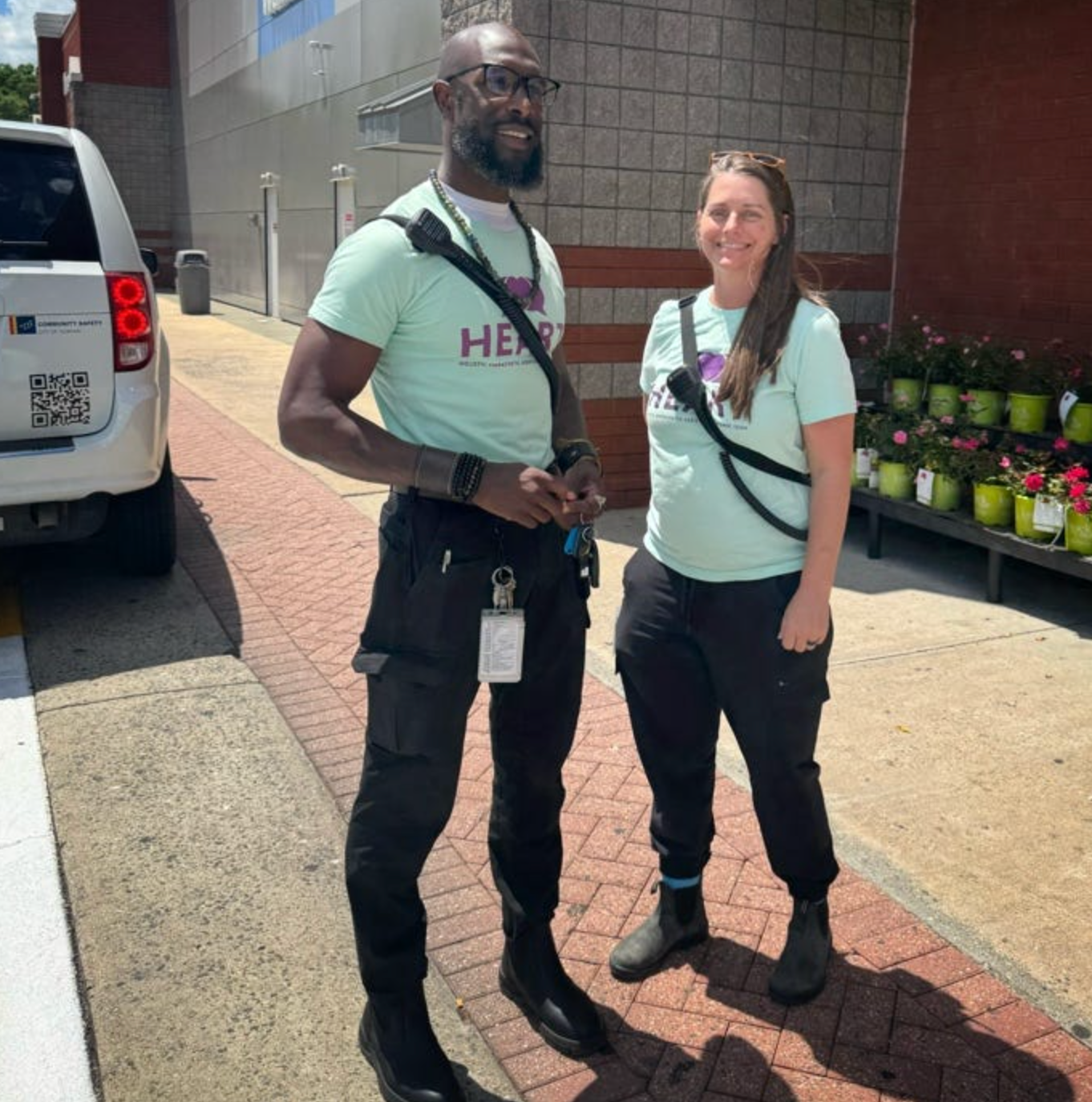
- In Durham, North Carolina, “HEART Program Shows Major Drop In Crime Reports Since Inception, Reshapes Crisis Response.” For ABC11 News, Akilah Davis reports that now, four years since its launch, Durham city leaders say that the HEART program has grown into a “national model” for mobile crisis response that, according to city data, has “reduced crime reports by nearly 60% and arrests by 56% while improving response times by more than three minutes,” and as Safer Cities recently reported, the HEART team recently marked a significant milestone of responding to more than 40,000 calls for service, saving Durham police “more than 8,000 hours in the last year alone, allowing officers to focus on calls requiring law enforcement presence.”
The HEART team, which “operates seven days a week for 15 hours a day with 51 staffers, though demand exceeds capacity,” responds to mental health and behavioral health-related calls for service, often pairing a trained clinician with another expert to aid people in the throes of a crisis. Ryan Smith, director of the community safety department and HEART’s first employee, who “helped build the program from the ground up”, ABC News noted, explained to the news station that “early skepticism [of the program and its role in the public safety infrastructure] has shifted as more officers see its impact… ‘every year we’ve seen growth in the number of calls we’re being sent to, and police officers showing up on scene saying, actually, what we need here is HEART.’”
- In Oklahoma City, Oklahoma, New Mobile Crisis Response Team “Responds To Thousands Of 911 Calls In First Year.” For The Daily Oklahoman, Jessie Christopher Smith reports on the promising first year of the city’s Alternative Response Team, which deploys trained mental and behavioral health professionals to 911 “mental health-related emergency calls [instead of] police… who can better address the caller’s needs.” In the first year of operation, the team is off to a strong start—according to city data reviewed by the newspaper, police historically responded to around 9,600 mental health calls for service annually, and “OKC police were primarily expected to handle behavioral health emergency calls by placing a person in protective custody.” But when ART first launched, the number of mental health-related calls to law enforcement quickly dropped to 6,900. Now, ART has responded to “more than 5,000 calls for service involving mental health issues since May 2025.”
Housed in the city’s Fire Department, the mental health responders are “comprised of four teams, including a Crisis Call Diversion team that triages and assesses behavior health-related calls at the 911 Communications Center; A Crisis Response Team [that] will respond to emergencies… [a unit that responds to] overdoses and less-acute mental health needs; and a [team] also exists for residents relying on 911 services involving non-emergency needs.”
Oklahoma City Police Department Sgt. Mark Fields, a champion of the mobile crisis response team explained to the newspaper that, “he and several other officers often wondered how effective they were actually being in helping people with mental health emergencies… [but now feels that] ‘…it’s amazing to be able to turn around and say, ‘Hey, I’m at the limit of what I can do, but here are these people that are not police… but they can connect you directly to services and they can follow up in regards to your mental health… they have a deeper knowledge base as far as conditions and medication and treatment options, and things like that.” Police Lt. Tim Land, who works with Fields, added that the team, “is game-changing, and I can see them being the cornerstone of Oklahoma City’s mental health response… as opposed to they’re helping us, we’re really kind of helping them. It’s a top-tier program. Oklahoma City is really lucky to have it.”

- In North Carolina, New Mobile Crisis Teams For Children Are Keeping Kids “Out Of The ER,” And Reducing Strain On Law Enforcement, By Sending Mental Health Workers Directly To Families’ Homes. For North Carolina Health News, Taylor Knopf reports on North Carolina’s new MORES program—“mobile outreach, response, engagement and stabilization”—which sends specialized mobile crisis teams directly to children and families experiencing behavioral health crises with the explicit goal of preventing unnecessary emergency room visits, psychiatric institutionalization, and repeated 911 calls that often pull in law enforcement response. The teams, now operating across 20 counties, pair “a licensed clinician trained in adolescent care and a family peer support specialist” and respond to the house before continuing in-home stabilization and follow-up support “for up to eight weeks after the initial visit.” Hospital leaders say the impact has already been dramatic—before the program, many children arrived through 911 and law enforcement transport and remained stuck in emergency rooms for weeks or months, but after partnering with MORES teams, one North Carolina pediatric emergency department saw the share of rooms occupied by long-term behavioral health “social holds” drop from “50 percent to 70 percent” of pediatric rooms to “fewer than 10 percent.”
Related: In Columbus, Ohio, voters overwhelmingly approved a new community crisis response amendment, with 77% voting in favor, formally creating a citywide mobile crisis response system of “clinicians, EMTs and social workers who will respond to emergency calls” involving mental health-related calls for service, WOSU News reported. The measure consolidates and expands the city’s alternative response infrastructure, including the mental health experts embedded in 911 dispatch, ensuring people in crisis receive “the right response at the right time,” reducing reliance on law enforcement for mental health-related calls.