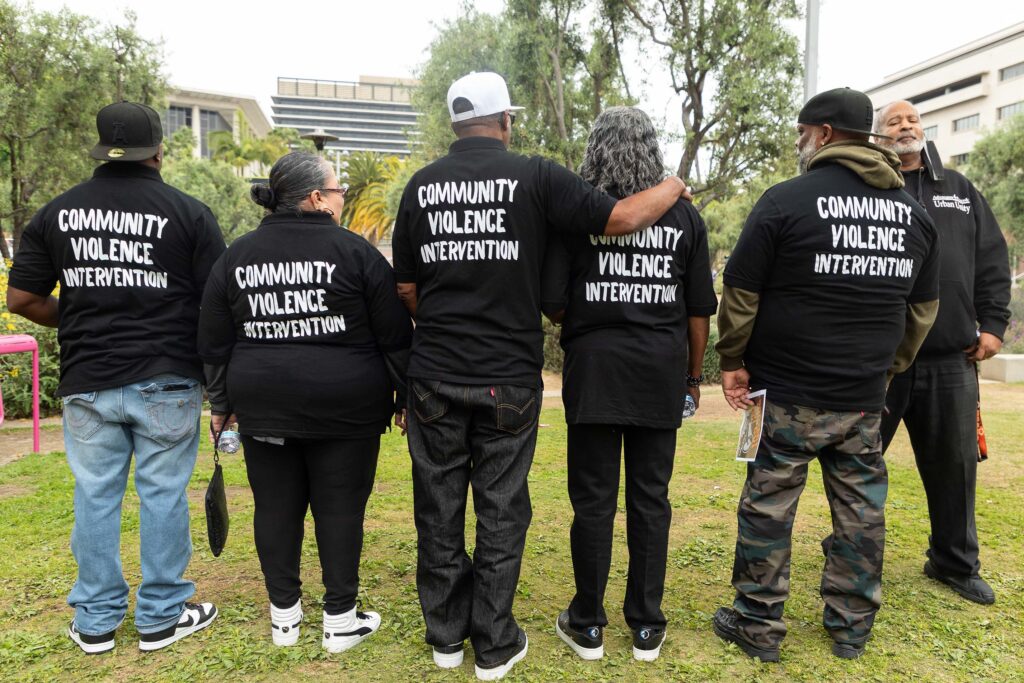
For the Milwaukee Neighborhood News Service, Devin Blake reports on new research reinforcing what violence interrupters have long seen firsthand: shootings are often preceded by clear warning signs and escalation—and intervening sooner could save more lives. The article highlights a critical insight—there is a far larger population than previously understood who report seriously thinking about harming others, but who, for a range of reasons, never act on those thoughts. That gap between ideation and action is exactly where community violence intervention efforts can make a difference.
That reporting draws on a startling new study from researchers at the University of Michigan Medical School, published in JAMA Network Open, which uses a national survey of 7,034 U.S. adults to examine the prevalence of thoughts about shooting others. The researchers identified a sizable population experiencing these thoughts—often without acting—highlighting a clear opportunity for intervention. As they conclude, this group “constitute[s] a poorly understood risk group who should be a focus for gun violence prevention efforts.” Here’s what researchers found:
- Millions Experience Violent Thoughts: The study finds that “3.3% of respondents seriously thought about shooting another person in the past 12 months… [that is] more than 8.5 million US residents” while “the lifetime prevalence was 7.3%… [that equates to] more than 19 million people.”
- Clear Points Of Intervention Exist Before Violence Occurs: Researchers identify multiple off-ramps before violence, noting that “1.5% of respondents… told another person they were thinking about shooting someone” and “0.5%… gave their gun to someone else for safekeeping during a crisis” while “1.5%… reported they would consider doing so in the future.”
- CVI Targets The Exact Moment Where Intervention Is Most Likely To Work: The study identifies a clear pre-violence intervention window which creates a real-time opportunity to step in before escalation, “a point of intervention” that aligns with CVI models that rely on trusted community members to de-escalate conflicts before they turn violent.
Momentum For CVI Teams Around The Country:
- In Detroit, Michigan “Record-Low Homicide Rates Show… CVI Works.” For The Michigan Chronicle, Ebony JJ Curry reports that Detroit closed 2025 with… [homicides] down 19 percent from [] 2024 and down 35 percent from [] 2023, continuing a multi-year decline,” and “one of the most consequential parts of the city’s briefing was… the city placing community violence intervention in the center of its public safety story.” City officials named seven CVI teams in operation around the city that have “produced reductions in homicides and non-fatal shootings that outpaced the reductions in areas without CVI coverage.”
- In San Bernardino, California, Hospital-Based CVI Program Expanding. Loma Linda University Hospital, which houses the region’s hospital-based violence intervention program, announced that the program is receiving a $4.7 million expansion to “provide new services to address unemployment and mental health, which are significant individual and societal risk factors for violent injury… including workforce readiness seminars with job interview coaching and job referral pathways, as well as counseling services and transportation or meal vouchers… [as well as] tattoo removal… a key part of workforce readiness and the only service of its kind in the Inland Empire.” The university said that the hospital-based program has “served over 1,500 patients over the last three years… helping patients and families of those who sustain a violent injury, such as injury from gunshots or stabbings, modify circumstances and address social needs that can help break the cycle of violence… [using] a multidisciplinary approach with [health professionals] specialized in violence intervention and prevention and trusted community-based partners to provide safety planning, services, and trauma-informed care to violently injured people.”
- In Chicago, Baltimore, And Fresno, CVI Programs Linked To Significant Reductions In Shootings And Homicides. A new report from the Center for American Progress highlights how city leaders are increasingly pointing to community violence intervention programs as a central driver of recent public safety gains. In Chicago, CVI programs have “been evaluated to show significant reductions in either shootings, homicides, or arrests for violent crime among participants,” while “areas that received the highest average quarterly investment in CVI and street outreach programs… experienced the largest public safety gains.” In Baltimore, researchers found that “the five longest operating sites of Baltimore’s Safe Streets program reduced homicides by an average of 32 percent during their first four years,” with city leadership emphasizing that these outcomes are “a testament to what is possible when we invest in… frontline violence interrupters.” And in Fresno, the CVI program “decrease[d] the rate of all gun-related crimes by 46 percent two years post-intervention,” with the mayor adding: “I know for a fact they’ve stopped shootings. I know that for a fact.”