A new preprint study by researchers at the University of Chicago examines whether embedding a crisis line clinician inside a 911 call center can safely divert mental health and suicide-related calls away from police. Using a quasi-experimental synthetic control analysis, the researchers analyzed 911 call data from Mesa, Arizona and compared it to 27 similar cities to isolate the impact of embedding a counselor in the emergency communications center. The model enabled 911 calls to be transferred directly to a mental health counselor. The researchers find that embedding a clinician “was associated with [] fewer police responses to suicide calls” and conclude that “emergency communication centers should consider embedding crisis line staff to divert calls from police.” The full study is worth your time, but here are some toplines:
- Embedding Clinicians Reduced Police Responses To Suicide Calls. The study finds that “Mesa’s suicide call rate was lower than synthetic Mesa’s by 22.27–47.96 calls per quarter per 100,000 people”… with results showing the differences were “greater than all placebo estimates” and “greater than all but one… or two placebo sites” across multiple quarters, suggesting the reduction is linked to embedding clinicians in the 911 system.
- Fewer Dispatches Translate Into Hundreds Of Police Hours Saved. The reduction in calls produced measurable operational benefits, as “the lower suicide call rate translated to an estimated 228.1–490.6 police hours [saved] per quarter in Mesa,” with officers otherwise spending significant time on these calls. The study notes this reduction “shows a potential benefit… for law enforcement agencies (through reduced labor associated with mental health crises).”
- Embedded Clinicians Improve Real-Time Call Routing And Build Trust. Researchers found the embedded role directly improved dispatch decision-making, noting “the crisis line specialist assisted with translating [emergency call center] call routing policies into actual calls” and “learning the [emergency call center]’s culture, policies, procedures, practices, and norms likely built… trust.” Further, researchers wrote that embedding clinicians “may facilitate interdisciplinary trust that enables call routing to crisis lines.”
Spotlight On Cities Embedding Mental Health Experts Into 911 Call Centers:
- Allegany County, Maryland “Launches Integrated Mental Health Crisis Response System.” The Cumberland Times-News reports on the launch of “an integrated mental health crisis response system, providing a direct link between 911 emergency services and the 988 Suicide & Crisis Lifeline”—a first for the county which now joins “a growing number of Maryland jurisdictions that have already integrated 911 and 988 services.” The integration in Allegany already started this month and “allows 911 dispatchers to route specific behavioral health calls straight to trained [mental health] crisis responders… ensuring that residents in mental or behavioral health distress receive immediate specialized clinical support,” while “helping reduce emergency room waiting times and minimizing unnecessary police involvement.” The mental health professionals can then provide support over the phone and also dispatch the county’s mobile crisis response team, composed of “clinicians and individuals with lived experience,” who operate as “first responders for residents experiencing a behavioral health crisis.”
- In Raleigh, North Carolina, “Mental Health Clinicians Are Now Embedded In Raleigh’s 911 Center.” For Axios, Mary Helen Moore reports that Raleigh has launched its pilot where “mental health clinicians are now embedded in Raleigh’s 911 center.” Here’s how the new pilot works: “A 911 call-taker who determines a mental health crisis is underway (and there’s no weapon present) will transfer the call to one of those embedded clinicians,” who will then handle the call, resolve the crisis over the phone if possible, or, when needed, dispatch a mobile crisis responder team. Dominick Nutter, the city’s emergency communications director, explained to Axios that “diverting crisis calls frees up [police and fire] to handle other emergencies,” and also provides people in mental health crises with a more appropriate response.
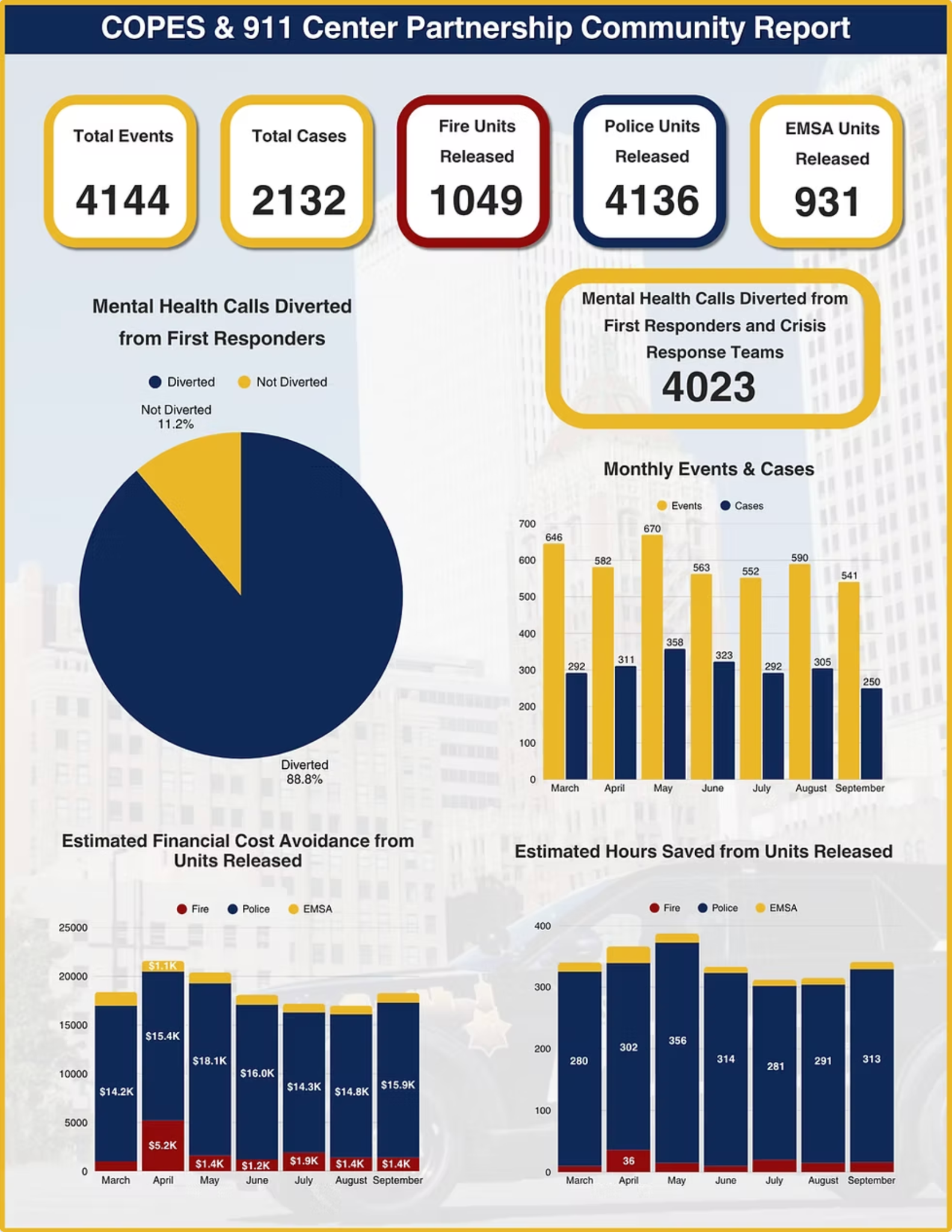
- In Tulsa, Oklahoma, “Mental Health Experts Started Taking Calls At [The] 911 Center. It’s Saving Taxpayers Money.” For The Tulsa Flyer, Joe Tomlinson reports on the most recent data from the city on Tulsa’s year-long effort to embed “mental health experts [] placed at the 911 center around the clock, freeing up police to prioritize public safety calls and saving taxpayers money in the process.” Since launching last March, the clinician-embedded team handling the mental health-related calls “has saved almost $109,000 for the police department, about $13,000 for the fire department and more than $3,000 for EMSA… [and] saved more than 2,000 dispatch hours for police, fire and EMSA units.” Andre Baul, an officer with the Tulsa Police Department, explained to the paper that the clinician “team has provided relief for officers… It helps the public in a way that is different than just seeing two cops show up at their door.” Here’s an infographic that illustrates some of the cost and time savings for the city, via the Tulsa Flyer: