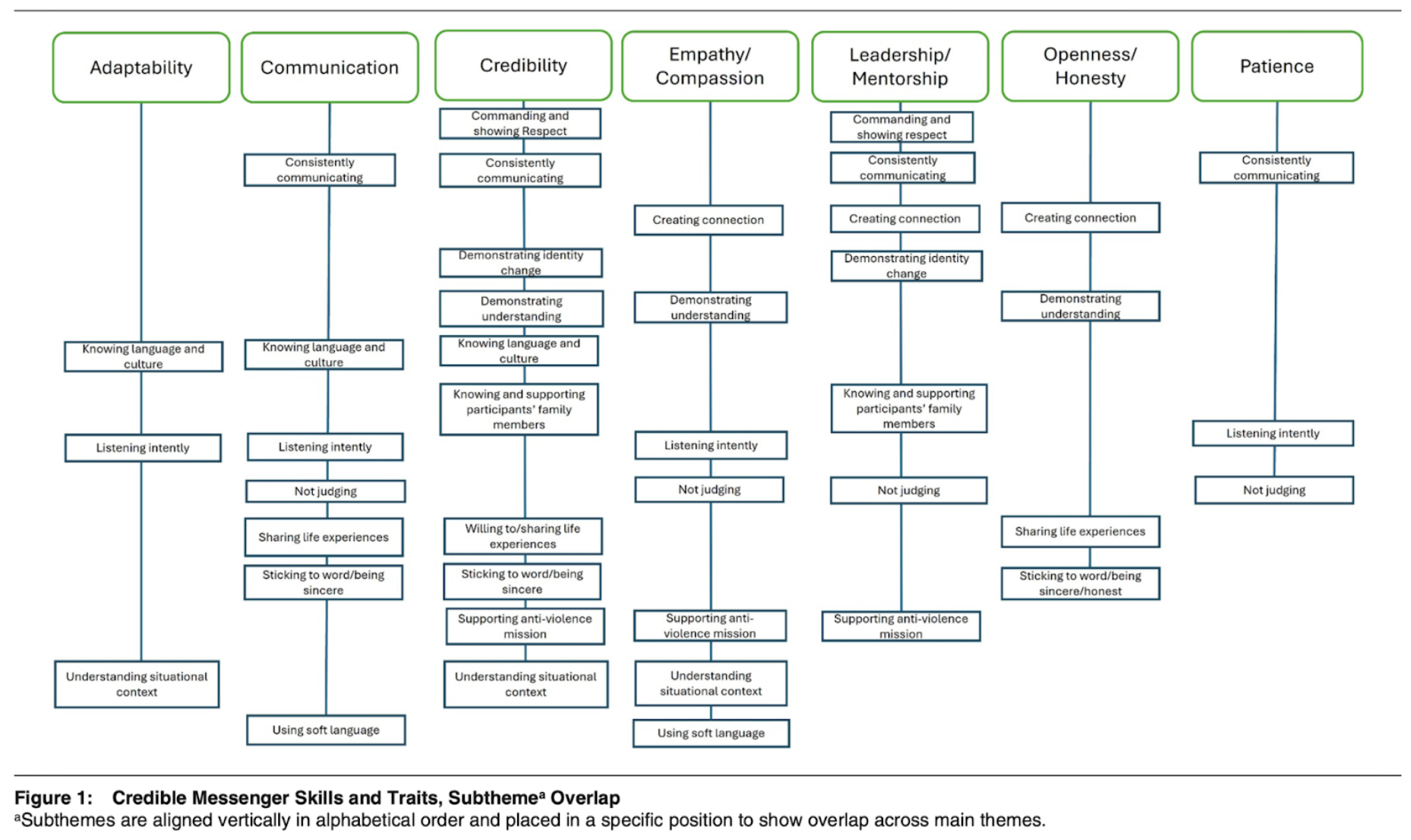
A new study published in Criminal Justice and Behavior by researchers at Temple University and the University of Liverpool examines what makes credible messengers effective in community violence intervention programs. Researchers conducted focus groups and interviews with 25 credible messengers across three Cure Violence teams, then used thematic qualitative analysis and member validation to identify the skills and traits that support effective outreach and behavior change. The researchers conclude that effective credible messenger work is “deeply relational and skills-based… [with] outreach workers supporting clients… as mentors [and] role models… mentoring individuals involved in violence and reducing fatal and nonfatal shooting victimization through relationship-based engagement.” The full study is worth reading for any policymaker considering implementing a CVI program, but here are some of the toplines:
Lived Experience Builds Trust That Traditional Systems Often Cannot:
Researchers found credible messengers’ lived experience is central to engagement, creating “contextual knowledge and relational credibility that cannot be fully replicated through training.” Outreach workers described how their personal histories — including exposure to violence, incarceration, and adversity — allow them to build deep trust with individuals at highest risk. These shared experiences help credible messengers “support clients by far more than just service provision,” instead acting as “mentors, role models, and desistance companions.”
Flexible Engagement Reaches High-Risk Individuals:
The study found credible messengers succeed because they tailor their approach to each individual rather than using rigid program models. Researchers note that “criminal justice programs often adopt a one-size-fits-all approach,” while outreach workers “tailor their engagement to each person’s circumstances and readiness.” This individualized approach allows credible messengers to adjust communication styles, support strategies, and timing based on client needs. Researchers found this flexibility “distinguishes outreach work from more rigid institutional approaches,” helping credible messengers engage individuals who are often hardest to reach.
Consistent Relationships Support Long-Term Change:
Through “consistent communication and emotional investment that is personalized,” outreach workers help individuals develop “a surrogate family… offering not just services but belonging.” The study found this relationship-based approach allows clients to engage without fear of punishment, noting individuals “do not have to be perfect and will not be punished or ostracized… if they make mistakes” and that sustained support helps individuals remain engaged and move away from violence over time.
Researchers also mapped out seven core skills that shape successful engagement from credible messengers; check that out here:

Spotlight On CVI Programs Reducing Violence Around The Country:In Baltimore, CVI Programs “Help Some Baltimore Communities Drastically Cut Crime.”
For CBS News, Kaicey Baylor reports on city leaders “crediting a decade of partnerships … [between] Catholic Charities and Safe Streets Baltimore… to declining violent crime statistics in Baltimore City… in 2025, Baltimore had the fewest number of homicides in about 50 years.” CBS News highlighted the CVI team in the Sandtown-Winchester community for “changing [the] neighborhood’s dynamic” through a team of trained credible messengers “born and raised in the community who are bringing necessary resources” into the neighborhood “mediating 91 potentially violent conflicts [just last year].” WBAL News spoke to community members in the Sandtown neighborhood who told the news station “‘You can tell that there has been violence prevented…[the CVI team has] done a good job with spreading the word that they’re around’… the signs of change show up in conflicts interrupted, retaliations avoided, and … a stronger network fighting for the community.”
In Denver, Colorado, Violence Intervention Program In “Northeast Park Hill Community Reduced Youth Violence By 75%…”
For The Conversation, Beverly Kingston reports that after launching the violence prevention effort in the Denver neighborhood, “the youth arrest rate in Northeast Park Hill fell to 276 per 100,000 – a 75% reduction” within five years. Researchers compared the neighborhood to a “carefully constructed ‘look-alike’ community… that did not receive the intervention” and found “Northeast Park Hill saw a sharper and earlier decline… pointing to an impact beyond national trends and tied to the local interventions.”
In Philadelphia, CVI Program Reducing Violence Through “Helping Young Men Change Their Thinking … Attending Therapy Sessions, Building Job Skills…”
For The Trace, Mensah Dean reports on Philly’s community violence intervention program that is helping people at risk of violence “turn their lives around.” Called P3, the program “enrolls participants [who are at risk of becoming victims or perpetrators of violence] from nine months to more than a year depending on their needs… [and] spend 200 hours in cognitive behavioral intervention sessions taught by credible messengers.” The program also provides participants with “professional development training, housing and financial assistance [,] transitional jobs while in the program and… help finding permanent employment and educational opportunities.”