In a new report published by Vera, researchers analyze publicly available New York City 911 call data from January through December 2025 to better understand what residents are actually calling for—and who is responding. Using the NYPD’s Calls for Service dataset, the team developed a classification methodology to distinguish call types into meaningful categories. The analysis focuses on nearly 3.7 million calls assigned to NYPD, offering one of the clearest pictures to date of real-time community needs. Researchers found that “Fifty-eight percent of the 911 calls… did not involve a crime… [and] more than one million calls… involved a range of social and health-related issues.” The authors conclude this data “illustrate[s] the opportunity to expand alternative first response… aligned with evidence on effective crisis response.” The full report is worth your time, but here are some topline findings:
- What People Call 911 For Often Doesn’t Match An Emergency Police Response: The dataset shows a wide range of needs beyond law enforcement: calls span “verbal conflict… mental health crises… [and] social and health-related issues,” pointing to demand for varied response types. Even when categorized as crime, incidents are often low-acuity: “the vast majority… (91 percent) did not involve violent crimes.” Many calls also lack clear immediacy—only “28 percent… reported a crime in progress,” while more than half are recorded as “possible” incidents rather than confirmed emergencies.
- A Large Share Of Calls Reflect Social Needs, Administrative Tasks, And Medical Issues: Researchers found that “about 21 percent of all 911 calls… were for administrative or directed action… not clearly related to crime,” including “vehicle accidents… automated alarm calls… [and] ‘see complainant.’” Health-related calls are a major part of the workload: “in about 18 percent of all calls… officers co-responded to medical assistance calls alongside EMS,” including “almost 150,000 calls… to a person who was in mental health crisis.” Social conditions also drive demand: “about 20 percent of all calls… reflected social issues… likely not related to violations of the law,” most commonly “disputes between people or a disorderly person or group.”
- More Than One Million Calls Could Be Better Served By Alternative Response: Researchers found that “more than a million calls… may be appropriate for alternative responses,” including “150,000” mental health crisis calls and “more than 510,000” conflict-related calls and that “trained civilian teams can effectively and safely serve as first responders… freeing up police to focus on… public safety concerns”… while also “connect[ing] people to services, de-escalat[ing] a crisis, and reduc[ing] the likelihood of arrest.”
Here’s a closer look at the call breakdown data from the report:

Mobile Crisis Response Teams Already Reducing Strain On Police Around The Country, Responding To Mental Health And Behavioral Health Calls For Service:
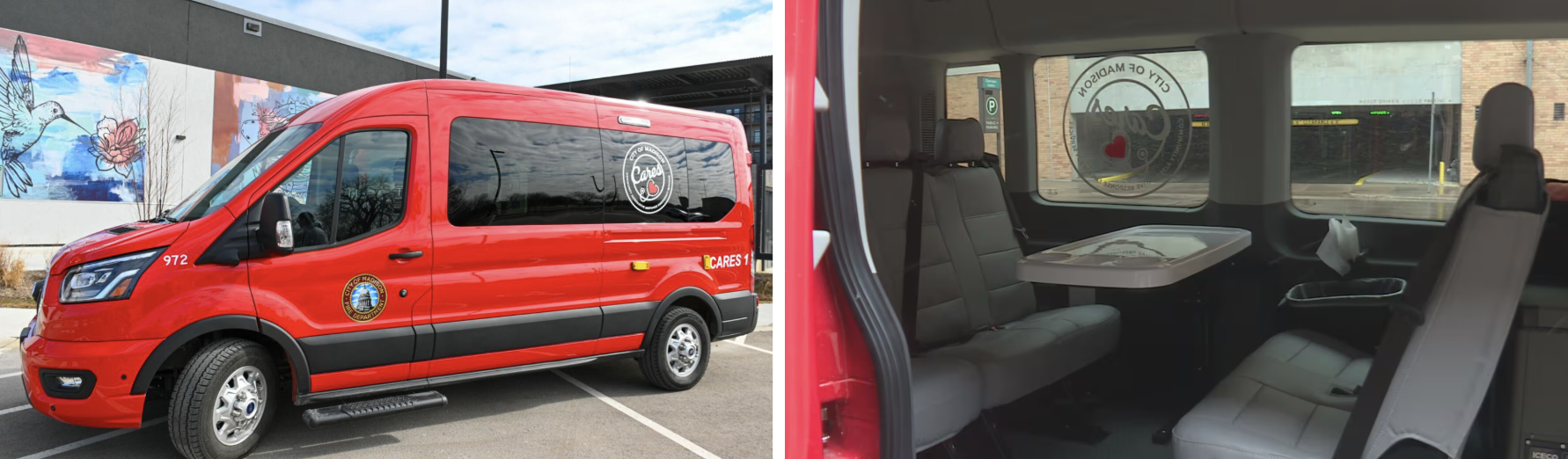
- Madison, Wisconsin’s Crisis Response Team Launches New Vans To Provide Mobile Care “To Keep People In Crisis Out Of Squad Cars, Ambulances And Emergency Rooms.” For WMTV, Tabitha Bland reports on the CARES mobile crisis response team’s expansion of their fleet with new treatment vans that allow the team to “bring services directly to people in need” and give “people experiencing behavioral health crises a private space to receive care outside of a hospital or jail setting” in the field, where many calls can be resolved quickly. The new vans are “equipped with … medication and supplies [and room] to allow one-on-one conversations and personalized care.”
- In Norfolk, Nebraska, New Crisis Response Team And Hotline Providing Treatment To People Who Previously “Struggled With Repeated Hospitalizations Or Involvement With The Justice System.” For Norfolk Daily News, Alejandro Ramirez reports on The Well, a longstanding behavioral health clinic “which provides mental health and addiction support services” across rural Nebraska, that has expanded to provide mobile crisis response within a 75-mile zone in the northeast of the state. Residents who call with a crisis are connected to “trained staff members who can assess situations and deploy crisis responders when needed… during behavioral health emergencies.” Donny Larson, executive director of The Well, including the crisis center and mobile crisis team, explained that “the expanded services have already shown positive results in the first months… [with] individuals who previously struggled with repeated hospitalizations or involvement with the justice system are now receiving more consistent support.”
- Austin City Council Renews Expanded Mobile Crisis Outreach Team For 24/7 Response. For KVUE, Brianna Perez reports on the City Council’s renewal with the city’s much-lauded EMCOT, which deploys “trained mental health professionals to complex psychiatric emergencies… [to] provide care that avoids unnecessary arrests or emergency room visits… [that] shortens response times for police and EMS while improving outcomes for people in distress.” The EMCOT responders are “ embedded directly in Austin’s 911 call center” so when people call 911 for help, they are given the usual options for routing their service (police, fire, medic), but are also given a fourth option of “mental health.” For those calls, EMCOT responds. Just last year, the team “handled more than 3,800 calls, freeing up police from having to respond to more than 90% of those calls,” local leaders explained to the news station.