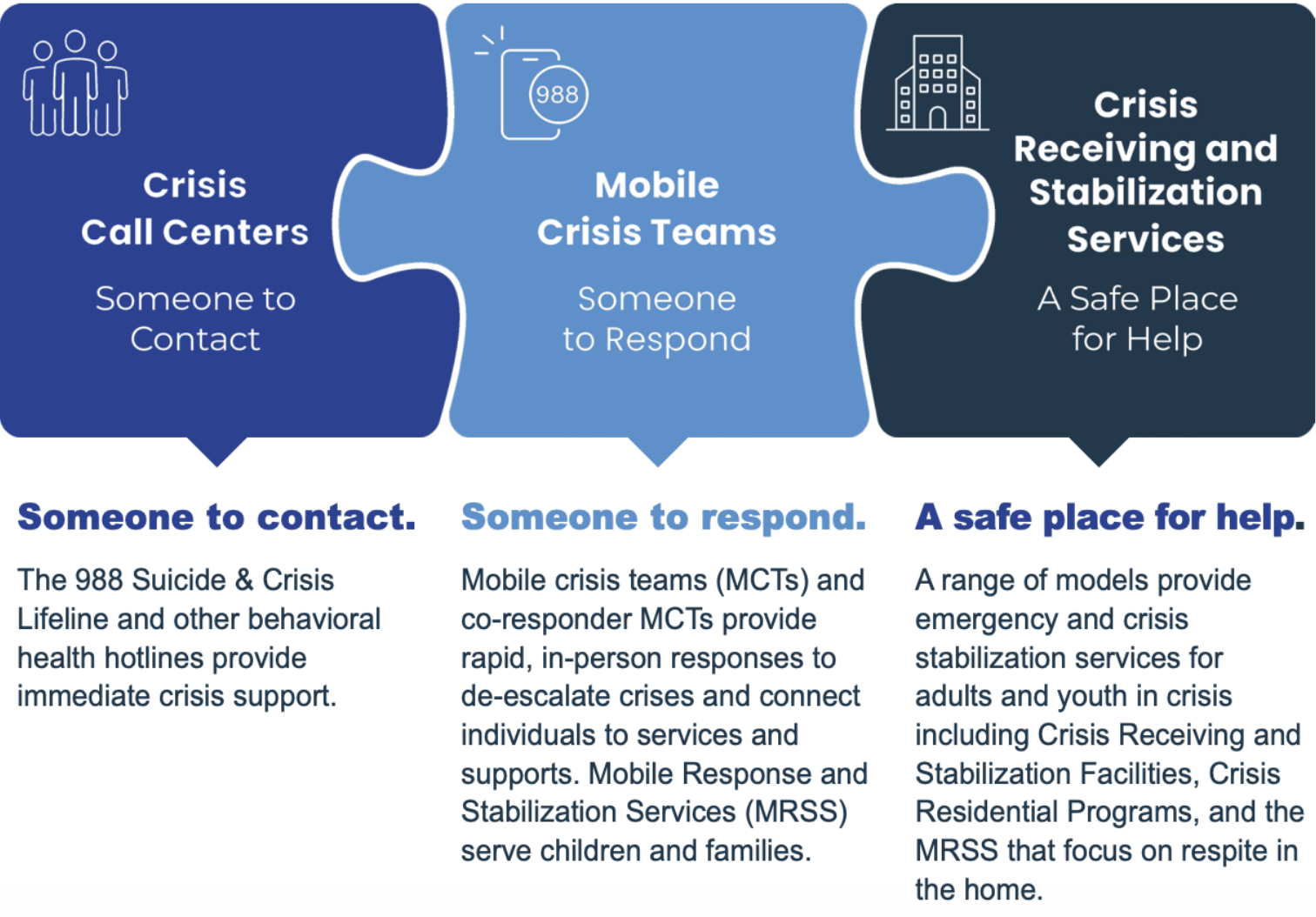
| In a new advisory published by the U.S. Substance Abuse and Mental Health Services Administration (SAMHSA), researchers and federal policy experts outline national model standards for crisis care workers as more cities, counties, and states are building out behavioral health crisis systems. Researchers conclude that workforce shortages remain the “largest barrier to providing crisis care services around the country” and argue that new credentialing standards can help “build a skilled, representative, and billable workforce with the capacity to meet demand across the continuum.” Here are some of the key findings from the report: Workforce Shortages Are Limiting Expansion Of Crisis Systems: The report warns the biggest constraint on crisis systems is workforce capacity, noting that “workforce shortages are the largest barrier to providing behavioral health crisis services 24/7 statewide” across the country. Nationwide, the shortage is severe: “122 million people in the United States lived in a Mental Health Professional Shortage area,” a number “approximately equal to one third of the population.” Rural communities are especially affected because they “have fewer providers per capita than urban areas.” A New Workforce Model Is Needed: Crisis systems depend on a wide range of responders “providing care across the crisis continuum,” including “social workers, licensed behavioral health workers, therapists, and certified peer specialists.” Because these roles have “different education and training standards … and provide differing levels of care,” the advisory argues that states should establish shared standards so crisis systems can function as an integrated workforce. Training And Credentialing Systems Are Key To Scaling Crisis Response: The advisory argues that formal training pathways are essential to scale crisis care, recommending national standards covering “core values, competencies, education and training requirements, certification, credentialing, supervision, and ethical standards.” These standards are intended to help states create crisis provider credentials and “build a skilled, representative, and billable workforce with the capacity to meet demand across the continuum,” enabling crisis care to be available “to anyone, anywhere, at any time.” |
 |
| Related: SAMHSA’s report follows a recent study, published in Psychiatric Services journal, that also found that the rapid expansion of mobile crisis response programs is outpacing the behavioral health workforce needed to run them. Researchers explained that the growth of this “third branch of public safety,” alongside police and fire, has been “hampered by limitations of the behavioral health workforce.” Nationwide shortages remain significant, with 34 states reporting gaps in mobile crisis staffing, particularly among “social workers and other licensed providers, peers, and bilingual staff.” To address the gap, the authors proposed creating a new professional role with “distinct values, competencies, and skills,” that expands on SAMHSA’s recommendations, including: Establishing a new frontline role—the “community behavioral health crisis responder.” The field needs “a new professional role… rooted in unique competencies rather than attached to existing advanced academic credentials,” allowing systems to recruit and train responders specifically for crisis work rather than relying solely on traditional clinical professions. Establishing statewide crisis workforce credentials. Researchers urge states to formalize the field through certification programs, recommending that “state behavioral health agencies as well as independent state and national credentialing agencies should establish and manage a credential.” Some states are already developing these certifications, helping define the skills, competencies, and standards for crisis responders. To scale the workforce and meet the demand, researchers recommend expanding training infrastructure—particularly through community colleges, which are “well positioned to prepare trainees for credentialing” and can serve as “a pipeline for the local crisis response workforce.” The report also proposes regional “centers of excellence” to provide training, standards, and technical assistance for crisis response workforce development. |