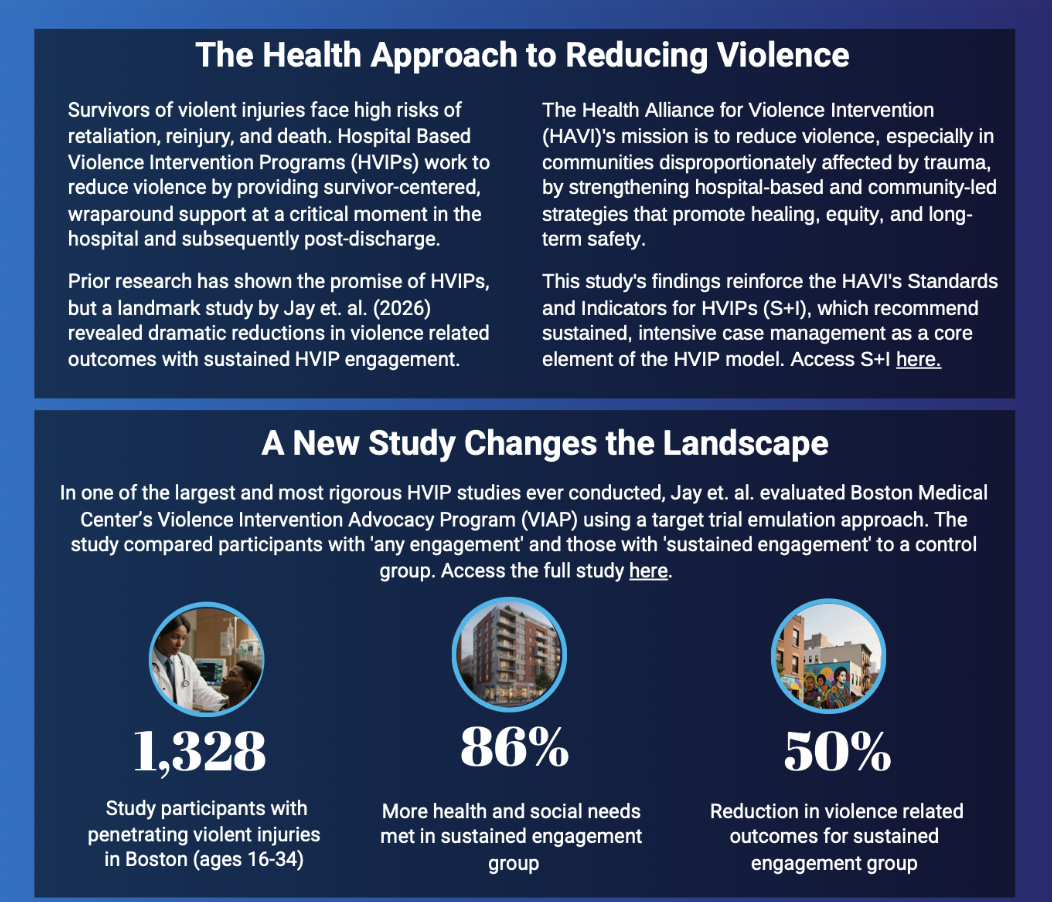
Study: “Consistent, Long-Term Engagement” In Hospital-Based Violence Intervention Programs “Can Cut Future Violence In Half.” 

Boston Medical Center along with the Health Alliance For Violence Intervention held a briefing this week about a “landmark” new study published last month in the Annals of Internal Medicine, from researchers at Boston University that found “a 50% reduction in violent injury or involvement in violent crime for participants of the Violence Intervention Advocacy Program, or VIAP, at Boston Medical Center… findings marking a significant milestone about the life-changing impact of hospital-based violence intervention programs nationwide.”Jonathan Jay, the lead researcher on the study as well as a professor at BU’s School of Public Health, explained to The Brink, BU’s magazine covering its latest research, that he and his research team “analyzed the records of 1,300-plus shooting or stabbing survivors, ages 16 to 34, who were at high risk of violence… almost half of them worked with VIAP sometime in the first month after their discharge, and the researchers found that brief interaction did not appreciably lessen the risk of future violence when compared with patients who never used the program. But the roughly 10 percent of survivors who regularly worked with VIAP in the first two months after discharge saw their likelihood of being involved in violence cut in half.”
Jay added that this is “the most important project I’ve ever worked on” because the findings could help other cities model effective hospital-based violence intervention programs after the success of Boston Medical Center’s program. The Brink’s Rich Barlow details how the program works:
“For survivors of gunshot and knife wounds treated in the emergency department, VIAP provides post-discharge help with mental health and family support services and assistance, if necessary, with connections to housing, food, employment, education, and other needs…. Currently, when someone is admitted to the hospital with a violent penetrating injury, they meet with VIAP patient advocates during their stay or soon after. Those advocates build relationships and conduct needs assessments to help target issues—from safety planning to mental health to housing insecurity—that could slow recovery or increase potential involvement in future violence … The mental health support is given in collaboration with BMC’s Community Violence Response Team.VIAP differs from other intervention programs [across the country]… in its unusually robust services—it has 13 staffers. Although the study focused on young adults, VIAP is more flexible than many other programs …  in its availability to violence victims outside of the highest-risk groups and in letting participants decide how often to avail themselves of its services.”
Jay explained that “People who get shot or stabbed are vastly more likely to have been excluded from systems—kicked out of school, kicked out of housing, to have some history of criminal legal system involvement so that it’s harder for them to get a job… [but as the VIAP data demonstrates] when people’s basic social and emotional needs are met, they are far less likely to be involved in violence…”Related: In a recent two-year study from UCLA’s Luskin School of Public Affairs, researchers examined the impact of the Newark Community Street Team—one of the country’s most prominent community violence intervention programs—to determine whether NCST’s model of community-based violence interruption works and whether it is scalable for other cities looking to launch or enhance their CVI offerings. The researchers concluded that NCST’s model “provides rigorous evidence that community-led violence intervention can significantly reduce violent crime” and “offers a scalable blueprint” for cities around the country. The full 200-page report and executive summary are worth your time, but here are some of the topline findings:Intervention Teams Deploy At The Same Time The Threat Of Violence Rises: Researchers found a “significant moderate correlation between high risk interventions and violent crime at lag 0,” indicating that NCST interventionists are deployed “simultaneously with violent incidents rather than operating on a delayed response model.” The analysis shows the program is “reactive and responding to an immediate need,” validating NCST’s strategy of “responding to, intervening in, and mediating community conflicts in real-time.”Resources Were Directed To The Communities With The Most Violence: Ward-level analysis confirms NCST directs resources to the neighborhoods most affected by violence—the South and West Wards, where violent crime rates are “approximately 2.5 times the national average,” receive the most concentrated programming. Researchers write the analysis “affirms NCST’s strategy of allocating resources to neighborhoods experiencing the highest burden of community violence” and reflects the program’s “decade-long evolution from pilot project to established practice.”Program Expansion And Community Engagement Growing: The study documents significant growth in the program’s activity and reach—“high risk interventions doubled between 2022 and 2023,” while participation in the Public Safety Round Table increased “from 2,207 participants in 2022 to 2,560 in 2023.” Researchers conclude this reflects “increased community engagement” and shows NCST is “building a generally more robust infrastructure” while continuing to “expand programming and outreach.”