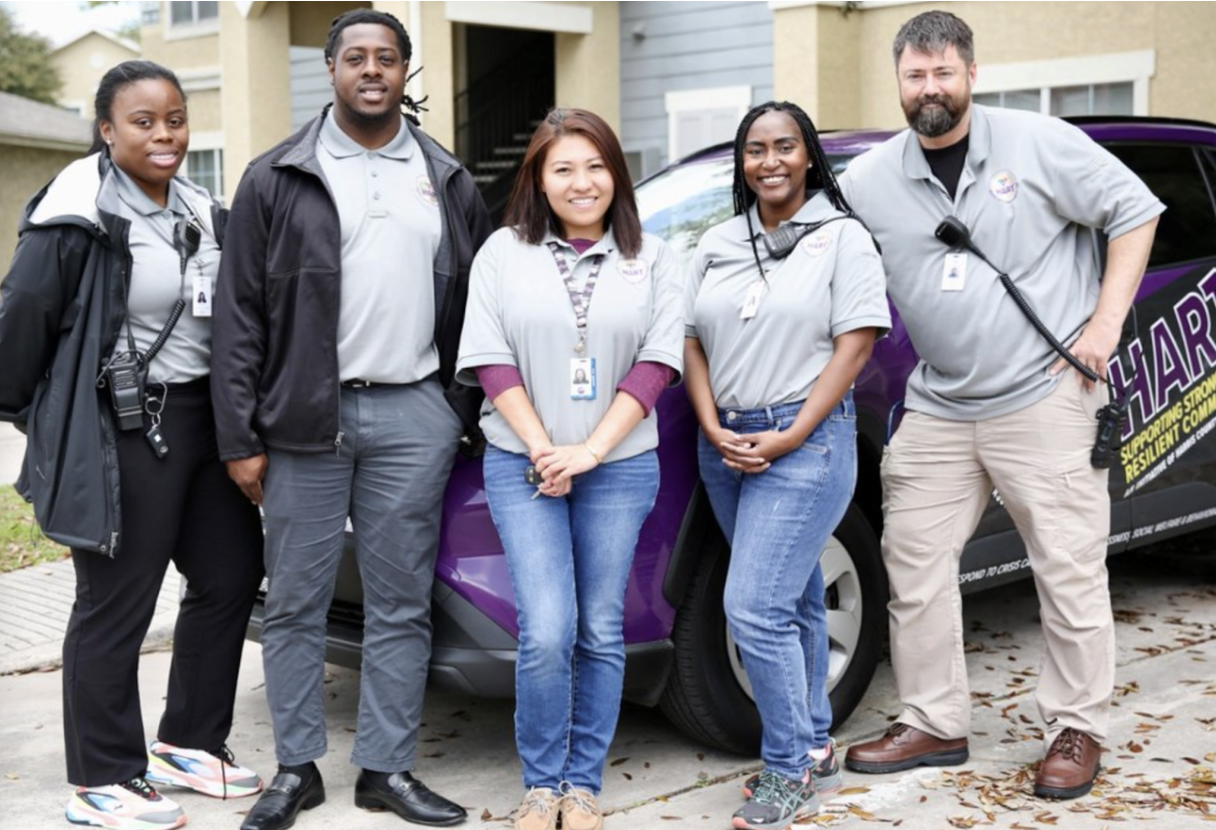
A young woman in Harris County, Texas took a bottle of pills out of her mother’s medicine cabinet and locked herself in her bedroom. The woman’s mother called 911 because she desperately needed help, but she also feared what would happen when the dispatcher sent a sheriff’s deputy to her home. She worried that the presence of an armed law enforcement officer inadvertently could escalate an already volatile situation.
Fortunately, in Harris County, there is a new pilot mobile crisis response program called HART—the Holistic Assistance Response Team—which is based in the county’s public health department and composed of healthcare experts, crisis intervention specialists, and case managers. The 911 dispatcher sent HART to help the young woman, who ultimately left the bedroom and got the care she needed, preventing what could have been a tragic death.
“This is about which expert should respond to a 911 call,” Harris County Commissioner Rodney Ellis, who helped spearhead HART’s creation, told Safer Cities: “When it’s a robbery in progress, or a shooting, then obviously we need to send an armed sheriff’s deputy. But if we are talking about a person sleeping on a sidewalk, or a teenager who is suicidal and swallowed pills, then we need a behavioral health expert to respond. That’s the kind of crucial work that HART’s crisis intervention specialists do everyday, and this is what it looks like to fully fund public safety in Harris County—we’ve got law enforcement, we’ve got mobile crisis response, and we’ve got community violence intervention. We are sending the right experts to solve the right problems.”

HART launched barely five months ago and recently responded to its 500th call. Not only are HART’s crisis intervention specialists able to de-escalate conflict and stabilize people in the throes of an acute mental health crisis, the team also helps people get to a safe space and connects them with additional support services. Then, in the days and weeks after the initial response, HART’s case managers follow-up with people who need more help. The team handles calls related to mental health, substance abuse, homelessness, and low level infractions such as loitering—fact patterns that typically result in a law enforcement officer arresting and charging a person and booking them into jail.
Commissioner Ellis explained that a lot of the program’s power comes from the basic idea that “public safety is a law enforcement issue but public safety is also a public health issue. By addressing the underlying mental health and substance use needs that led to the 911 call in the first place, HART can resolve the immediate situation, get the person the help they need to stabilize their life, and make it much less likely the person requires an emergency response in the future.”