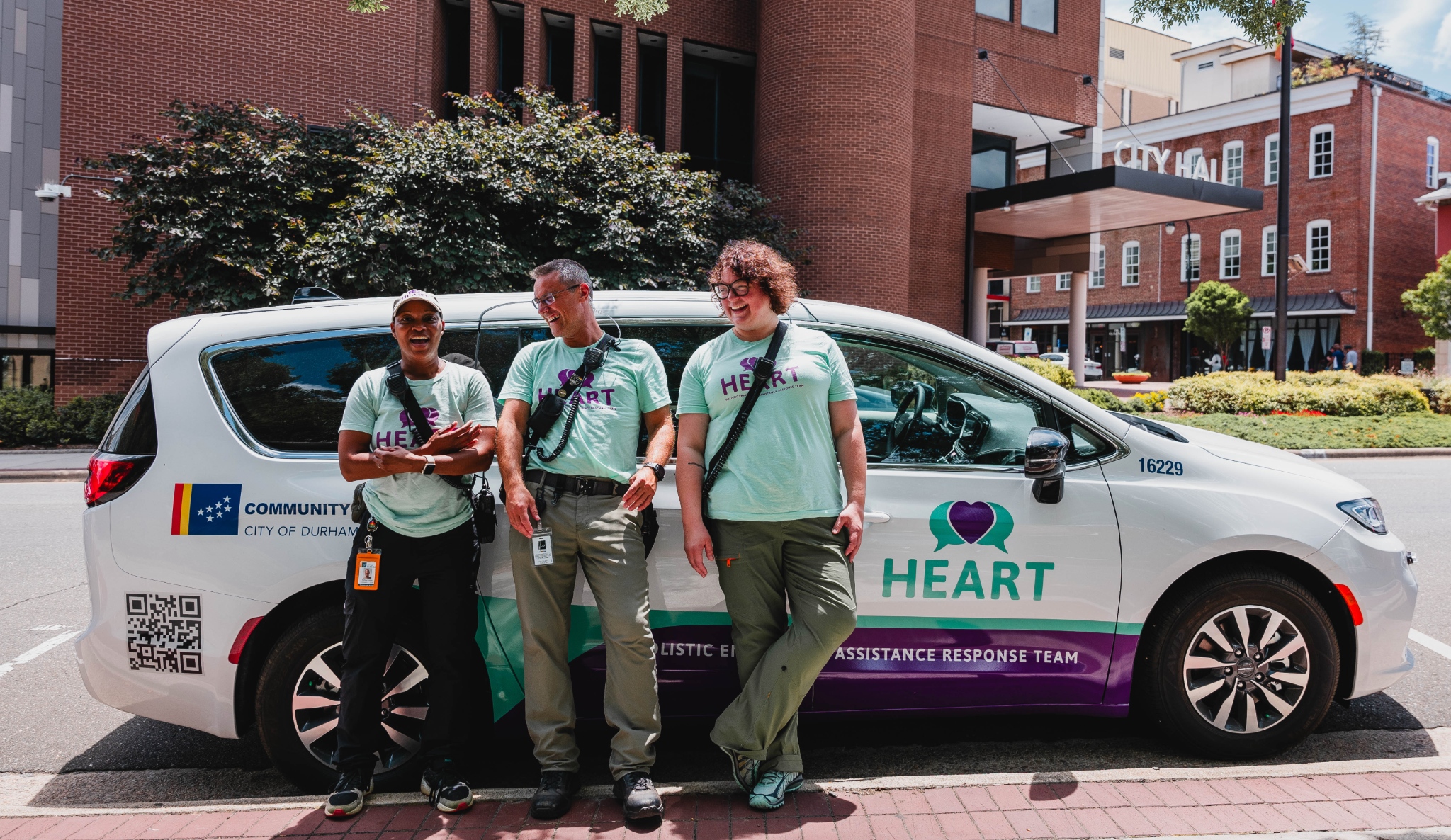
Community Safety Departments serve as a third, co-equal branch of a city’s public safety infrastructure alongside police and fire, bringing together specialized teams to respond to a broad range of community needs. Established in 2021, Durham’s Community Safety Department provides services ranging from housing and street outreach to reentry support, gun violence survivor care and behavioral health crisis response. Among its standout programs is the much-lauded Holistic Empathetic Assistance Response Team, or HEART, which embeds clinicians in 911 dispatch and sends teams of mental health professionals to emergencies. A recent evaluation by RTI International found that HEART’s unarmed Community Response Teams were associated with “significantly lower rates of offense reports, arrests, and citations relative to patrol-only responses” to comparable calls. Researchers concluded the model was “a good investment for the city.”
Safer Cities recently spoke with Leigh Mazur, Assistant Director of Durham’s Community Safety Department, about connecting residents to care, matching emergencies with the right responders and building effective multidisciplinary teams.
- On Connecting People To Services: “The biggest opportunity has been meeting people where they are with support that fits what they’re actually going through. Often, our teams can connect a neighbor with exactly what they need in their moment of crisis, whether that’s a safe place to stay, a link to treatment, or simply someone who listens and helps them through. And because we’re the ones answering these calls now, we see community needs firsthand and can document them, which gives us an opportunity to push for change across the larger system… Sometimes we sit with a neighbor while they call local shelters and learn there isn’t a single open bed, and all we can offer that night is a hygiene kit and a blanket… But every one of those calls tells us something about what our community is missing, and it’s why we keep advocating for system change.”
- On Integrating HEART Into 911 To Send The Right Response To The Right Crisis: “HEART is built directly into Durham’s 911 system. Our Crisis Call Diversion clinicians work inside the Emergency Communications Center, right alongside 911 call-takers and dispatchers. When someone calls about a behavioral health concern, a welfare check, or a quality-of-life issue, the call can be routed to one of our clinicians, who can often help resolve it over the phone… When someone needs an in-person response, each call is assigned a call type, and CAD uses it to automatically recommend which team should go. That makes the decision clear and consistent from call to call.
If there’s no sign of weapons, violence, or a serious medical emergency, our Community Response Team can respond without police. When there’s more risk involved, our Co-Response team pairs a clinician with an officer. Our goal is to send the response that best fits the need, so people in crisis get care, and police and fire can focus on the calls only they can handle.”
- On Building Effective Teams Through Shared Purpose And Training: “It starts with shared purpose. Our teams bring together mental health clinicians, peer support specialists, and EMTs, and each sees a crisis through a different lens. One notices the mental health need, another the medical risk, another what it’s like to have lived through something similar. What connects them is a commitment to meeting neighbors with care… From there, it takes intentional investment. We cross-train so everyone understands what their teammates bring and where each role’s limits are. We build shared protocols so the whole team knows what to expect on a call. And we invest in supervisors and leaders who can help teams debrief and learn together after hard calls.”