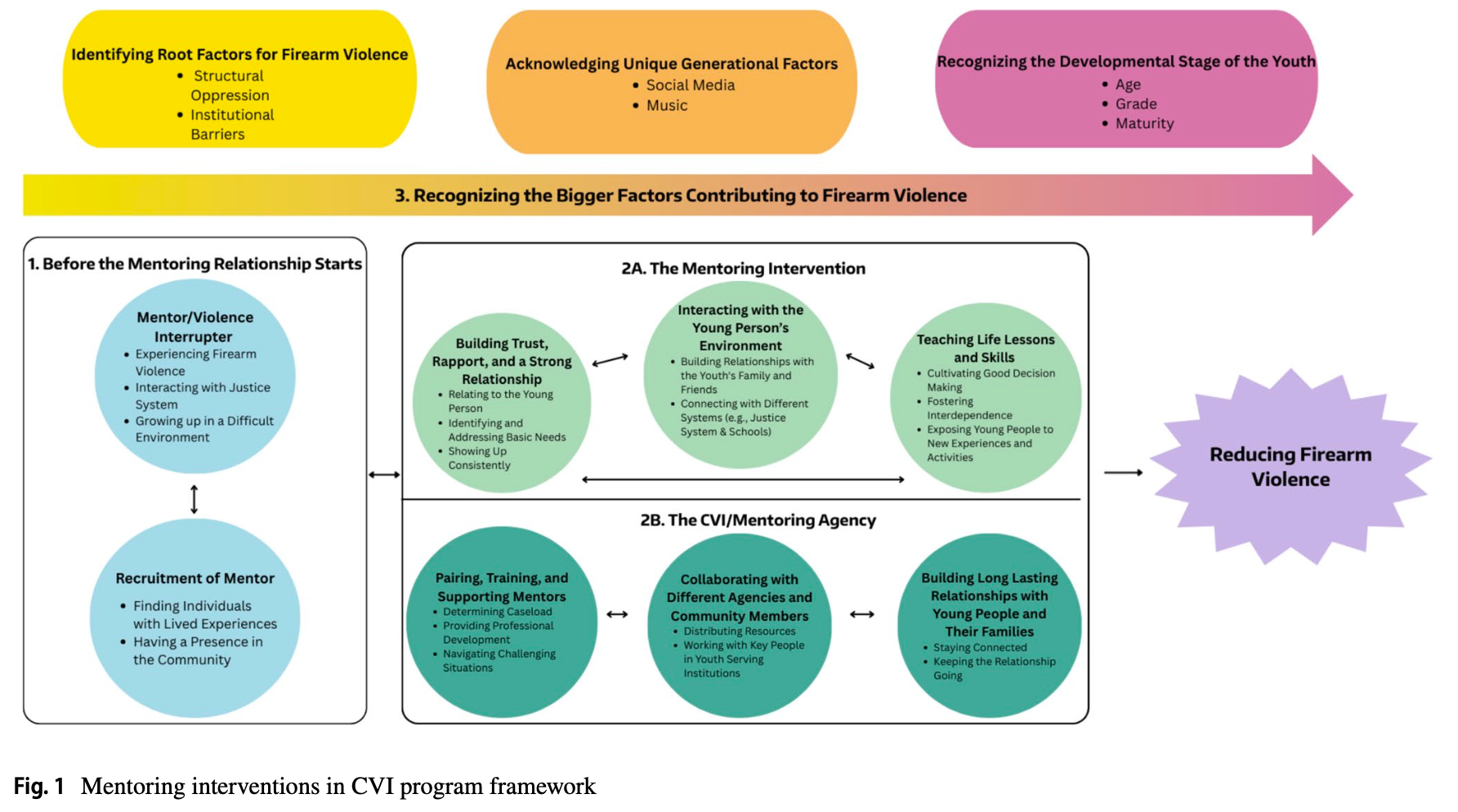
1. Study: “Perspectives from Mentors and Administrators in Community Violence Intervention Programs.” In a recent study published in Prevention Science, researchers from the University of Washington interviewed 20 mentors and administrators working in community violence intervention programs across Washington state to identify the practices they believe are most important to preventing firearm violence among young people. Using those interviews, the researchers developed a practical framework describing the common components of successful violence intervention programs, concluding that the study “illustrates the components in mentoring interventions within CVI programs…perceived as essential in preventing firearm violence among young people.” The full study is worth your time, but here are some of the topline findings:
- Shared Lived Experience Builds Trust Among Participants. Researchers found successful CVI programs “actively seek out and recruit … individuals with [] specific lived experiences [from the community]” and a program administrator explained why: “They really have to have the knowledge of that [community]. Not read it in some book … because it’s just different [for credibility].” Another administrator said recruitment into the CVI program depends on community relationships because “there’s no website where you can go to find people with lived experience … so, you really gotta talk to people in the community.” One mentor recalled a young person telling him that he trusted his mentor explicitly because he had similar lived experience and was “the only one that understands what it’s like… we really appreciate you coming here…”
- Successful CVI Programs Pair Mentoring With Practical Support. The researchers conclude that “mentoring to prevent firearm violence is impossible without addressing basic and essential needs,” including “housing, food, safety.” They describe mentors “providing a young person with clothes … helping a young person go through the process of getting their driver’s license … helping a young person apply for a housing program.” One mentor added: “If you have a client that has probation appointments, I always try to offer to take them there … [some] parents are working or [some] parents aren’t involved, so … mentors help do that and get them there.”
- Families, Schools And Probation Are Integrated Into The Intervention. The researchers found “the family is a vital aspect of the service provision,” with mentors working across the systems surrounding young people. One mentor said it’s about “transforming it into their language … to go over paperwork, to go over plea deals, so they know what they’re signing.” Another mentor explained, “We have a caseload meeting where probation officers and other people are involved,” while one program administrator said, “It’s very critical that we collaborate with school systems, because they have our kids majority of the time… and so understanding and training them, giving them awareness… [builds better outcomes].”
Momentum For CVI Programs Around The Country:
- Milwaukee Launches Initiative To Expand Violence Intervention Programs Countywide. For the Milwaukee Journal Sentinel, Zachary Suri reports Milwaukee County announced a $1.5 million grant from the Wisconsin Office of Violence Prevention aimed at expanding the promising CVI programs in operation throughout the county. David Crowley, County Executive, explained to the newspaper that the initiative will combine new investments with existing violence intervention and mental wellness programs to “help us reach people before violence reaches them and create opportunities and hope for young people across Milwaukee County.” For Wisconsin Watch, Devin Blake reported that the initiative will connect residents with employment opportunities, housing assistance, mental health support and violence intervention services while building on existing programs that have already shown promising results. According to the county, “95% of [CVI program] fellows reported no new gun injuries and that 76% of youths who participated in [the program] recently had no referral or offense while in the program.”
- Albuquerque Expands Violence Intervention Program With Trauma Therapy And Youth Economic Support. Albuquerque Community Safety Department, which oversees the city’s CVI program, announced two new initiatives expanding the city’s Violence Intervention Program, including a $600,000 partnership with Youth Development Inc. to provide therapy, trauma recovery services and case management through the city’s Trauma Recovery Center. Mayor Tim Keller said the investment will strengthen the center’s ability to “connect Albuquerque residents with healing, support, and hope,” while YDI CEO Robert Chavez said the partnership will “expand access to proven therapeutic services that help individuals and families recover from trauma and build safer futures.”
ACS also announced a second initiative providing 20 young people participating in the city’s School-Based Violence Intervention Program and Youth Violence Intervention Program with $750 per month for one year, paired with job training, educational support, therapy, financial counseling and mentoring. ACS Director Jodie Esquibel said the program “helps remove barriers while creating pathways to education, employment, and long-term success.”
- In San Antonio, “Data Shows Violence Prevention Programs Work.” For the San Antonio Report, Diego Medel reports on new city data showing declines across every major category of violent crime between 2022 and 2025, including a 56% reduction in homicides and a 46% decline in shootings, while highlighting the city’s violence interruption program as a key component of those results. Violence Prevention Administrator Erica Haller-Stevenson noted that the city’s CVI program interrupted 488 violent conflicts in fiscal year 2025—conflicts that “had the potential to escalate into shootings,” while Councilmember Teri Castillo, a champion of the city’s CVI program, explained that the program works because it connects residents with “mentors, employment opportunities and other support before they become involved in violence.”
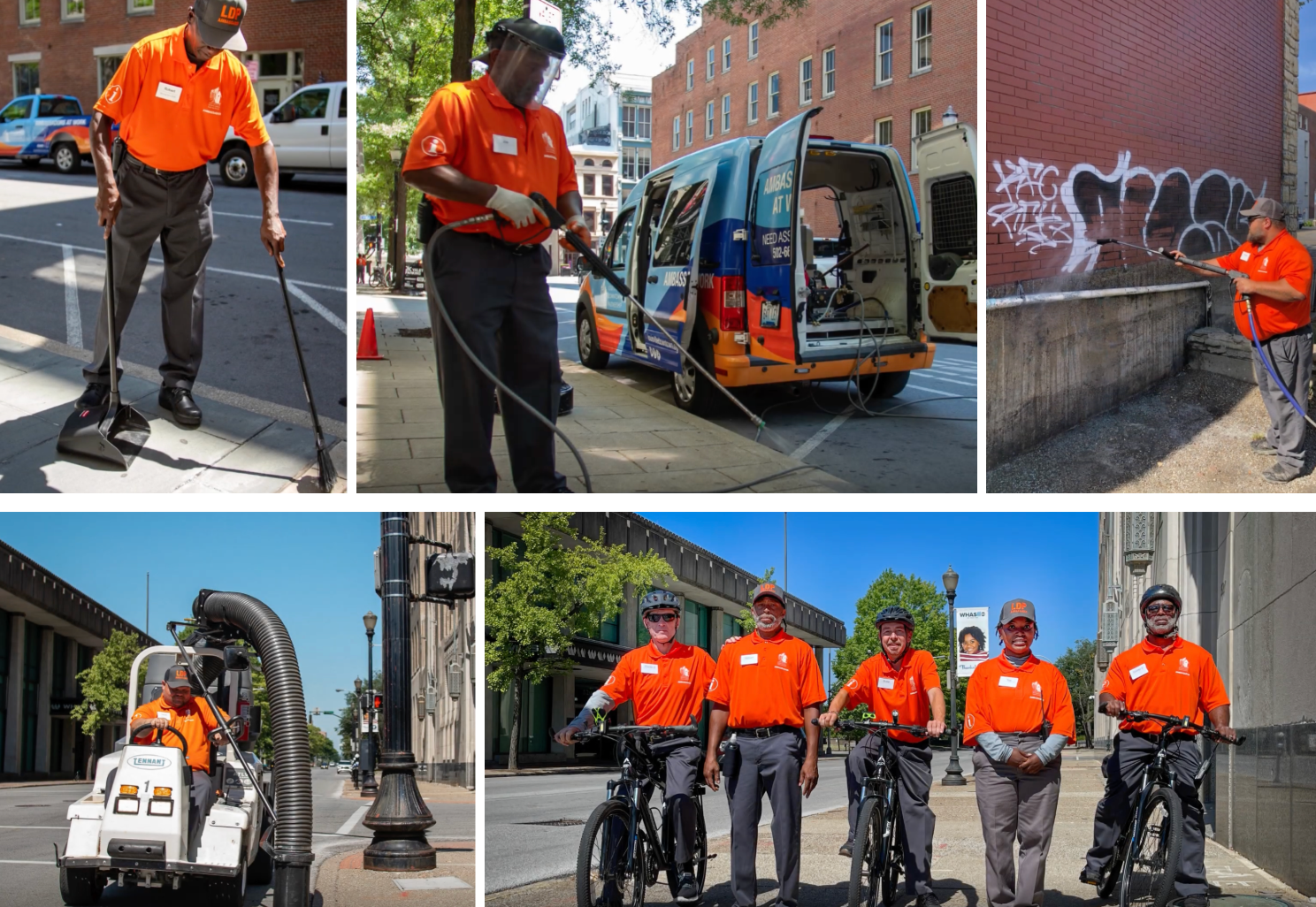
2. Safer Cities Interview With Louisville’s Clean Team. Clean teams help make public spaces safer and more welcoming. They remove litter, graffiti and hazardous waste, helping ensure no parent has to worry about their child stepping on a dirty needle while walking to school or playing in the park. Some programs also pair those services with Safety Ambassadors who serve as extra eyes and ears for downtown neighborhoods, providing hospitality, safety escorts, business outreach and connections to emergency services.
One of the nation’s longest-running examples of this two-pronged approach is in Kentucky, the Louisville Downtown Partnership’s Ambassador Team, which has served Downtown Louisville since 1995. Today, ambassadors work seven days a week across more than 100 blocks, removing an average of 2,000 pounds of litter each week while assisting visitors, supporting local businesses and reporting emergencies.
Safer Cities recently spoke with Rebecca Fleischaker, Executive Director of the Louisville Downtown Partnership, about how the program helps strengthen downtown safety and vitality.

- On How Clean Streets Help People Feel Safe And Welcome: “Clean, inviting streets signal that you’re in a place where you’re meant to be. When a space looks and feels maintained and welcoming, people are attracted to it and feel more confident in being there, visitors will linger longer, residents take pride in their neighborhood, and businesses benefit from increased foot traffic.”
- On The Many Roles Clean Teams Play Beyond Cleaning: “Beyond regular litter abatement, the LDP Ambassador Team shares public safety information, stays connected with business owners, assists visitors, shoppers, workers, and residents, and provides safety escorts upon request. Their work also includes weed and graffiti removal, sidewalk pressure washing, and hanging the colorful banners that line our streets.”
- On Expanding Services To Reach More Of The City: “The LDP Ambassador Team works seven days a week beginning at 6am and covers the approximate 100 blocks of Downtown Louisville’s Business Improvement District. The district has evolved over the decades as new buildings and businesses have been added to the service area.
In 2025, this boundary grew to include the northeastern portion of Downtown including the baseball park and a two-block area adjacent to the Louisville Medical & Education District. The expansion filled a critical service gap and strengthened connectivity across the district.”
3. Cities Expand Crisis Stabilization Centers As Alternatives To Jail And Emergency Departments.
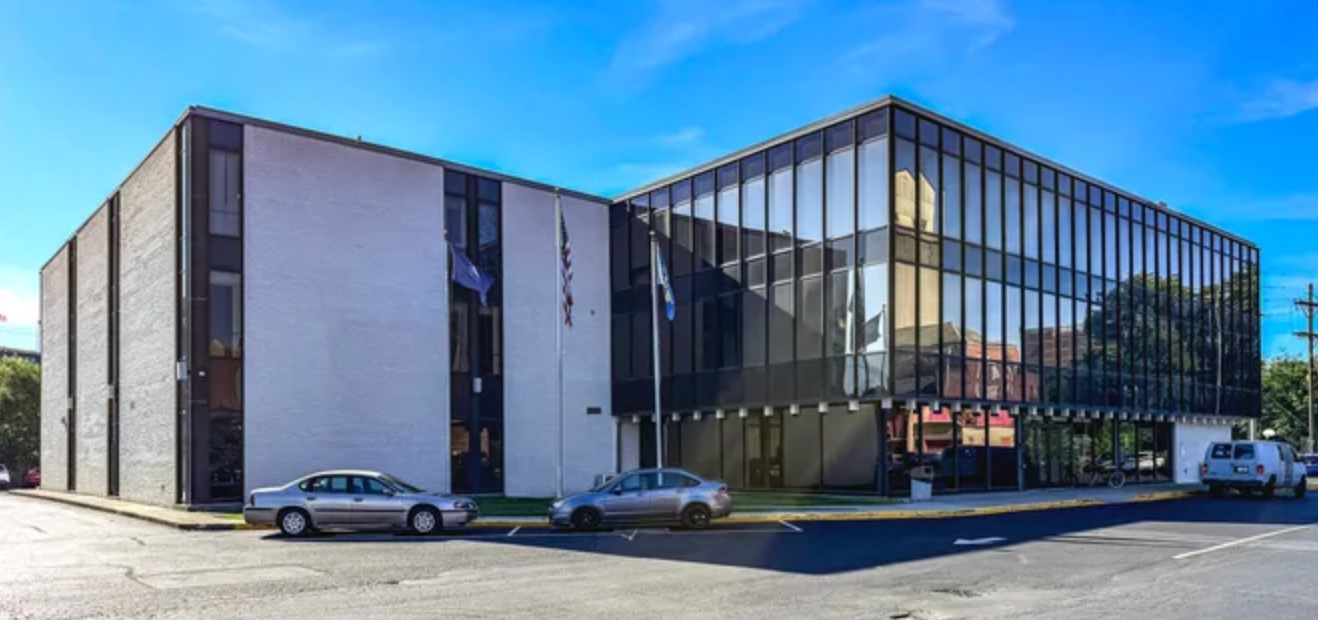
- Miami-Dade Approves New Crisis Stabilization Center To Shift People From “Jail Cells To The Treatment Center” And “Break A Cycle Of Crime, Jail And Homelessness.” Miami Today reports that county commissioners unanimously approved opening the Miami-Dade County Mental Health Center, a 75-bed facility designed to provide “a comprehensive, one-stop system of care” that shifts people “with mental illness from jail cells to the treatment center in hopes of breaking a cycle of crime, jail and homelessness.” The center will offer crisis stabilization, substance use treatment, residential and outpatient care, transitional housing and an on-site courtroom to expedite diversion into treatment. For Local 10, Christina Vasquez spoke with Judge Steven Leifman who explained that the center will provide “a full continuum of care under one roof… [and] gently reintegrate them with housing, peer support, treatments, supportive employment opportunities, everything that they need.” County Commissioner Raquel Regalado, a champion of the facility, said “For two decades, too many of our neighbors with severe mental illness have cycled through jails instead of getting the treatment they need… This is a victory built on compassion, teamwork and common sense.”

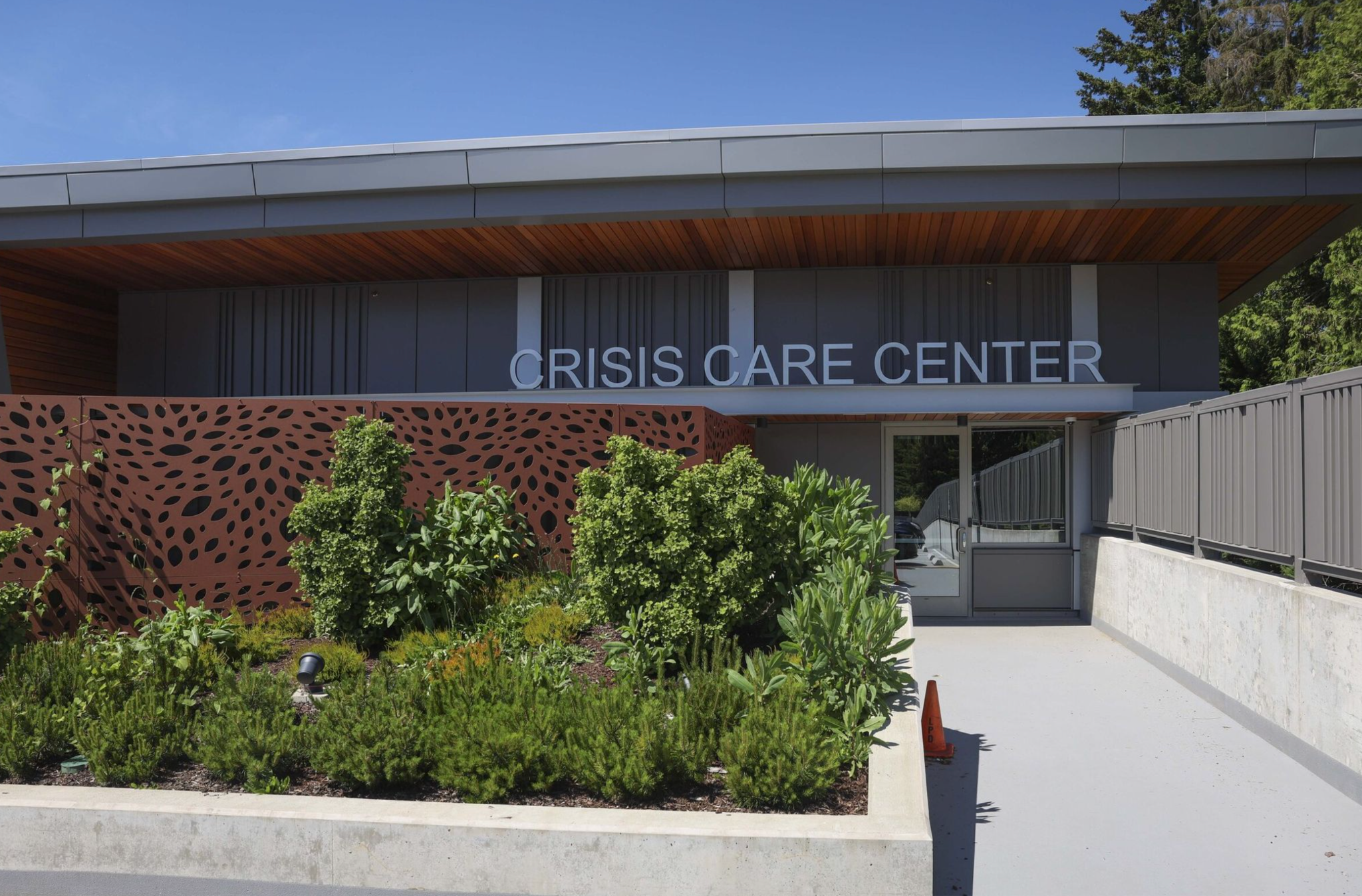
- In Louisville, Kentucky, “New Mental Health Crisis Center To Be Alternative To Jail, Hospitals.” For the Courier Journal, Killian Baarlaer reports that Louisville is opening a new mental health crisis center next month that will serve as “an alternative to jail or hospitals” for people experiencing behavioral health crises. The voluntary, community-based center will complete Louisville’s crisis care continuum by providing the “safe place for help” alongside 988 and the city’s mobile crisis response team, while also connecting people with licensed therapists, nearby hospitals and community partners addressing homelessness and food insecurity. Metro Police Chief Paul Humphrey, a champion of the new center, explained: “LMPD officers want more options. They need more options for what to do with people in mental health crisis. We want to be able to direct people to the resource that is most appropriate for them…”
- Lynnwood, Washington, Opens New Crisis Stabilization Center To Serve As “An Alternative To An Emergency Room Or Jail” For People In Mental Health Crisis. For The Seattle Times, Taylor Blatchford reports on the City of Lynwood opening the doors on its new crisis center, which will provide 24/7 mental health crisis services regardless of insurance status or ability to pay while accepting drop-offs from all first responders and serves “as an alternative to an emergency room or jail for someone who is experiencing a mental health or substance use crisis.” For the Herald, Jenna Peterson spoke with Lynnwood Police Chief Cole Langdon, a champion of the new center, who explained that instead of taking someone in a mental health crisis to jail, “ this will allow them to be part of our community, to come in here and get checked in and get stabilized, so [they] can get back out to live and be a part of our community.”