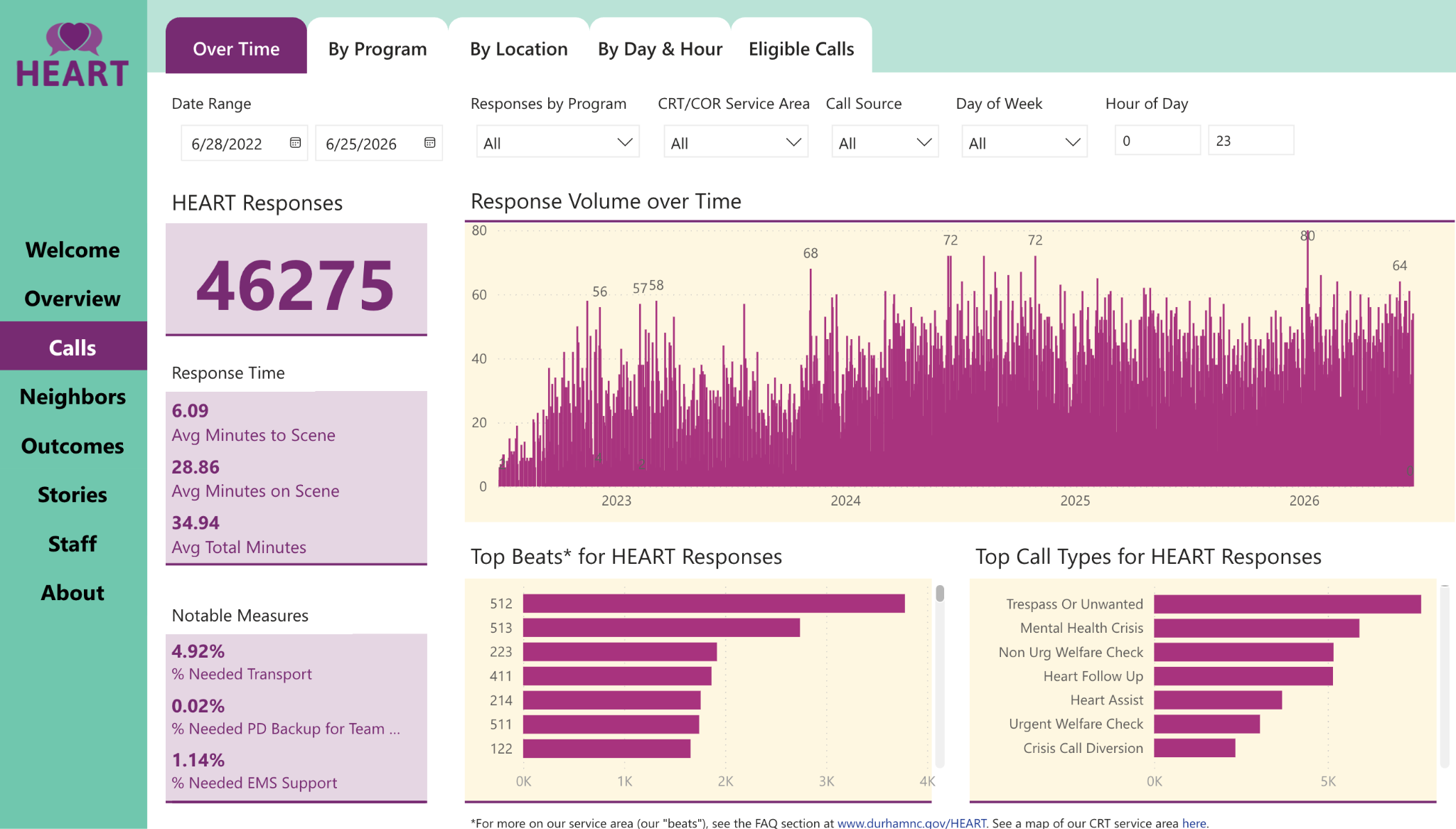
A new report published by research institute RTI International examined Durham, North Carolina’s Holistic Empathetic Assistance Response, or HEART, program— a widely watched mobile crisis response model funded by the City of Durham and operated by the city’s Community Safety Department. As Safer Cities recently reported, HEART hit a major milestone this year, having responded to more than 45,000 emergency calls since its launch and has “helped avert thousands of crises and alleviated a strain on the police department.” For this evaluation, researchers analyzed HEART’s first three years in operation, drawing on data from HEART, Durham 911 dispatch, and Durham Police Department records, and using a quasi-experimental design to compare HEART-eligible calls handled by HEART with similar calls handled by patrol when HEART was unavailable.
Researchers found Durham’s model is delivering on exactly what many cities hope to achieve with mobile crisis response teams: reducing strain on law enforcement while improving outcomes for people experiencing mental health crises. Researchers conclude that deploying trained “community responders … to 911 calls instead of law enforcement is associated with fewer enforcement-related outcomes,” the researchers write, including “significantly lower rates of offense reports, arrests, and citations relative to patrol-only responses.” The full report is worth your time, but here are some toplines:
- Reduces Strain On Law Enforcement. RTI found that crisis response team “deployment is associated with significantly lower enforcement actions compared with patrol-only responses for comparable eligible calls,” with the “clearest incident-level outcome differences” showing “a meaningful reduction in arrests and, to a lesser extent, citations.” Researchers conclude that these findings represent “one of the clearest incident-level outcome differences observed” for HEART, showing that the model can reduce unnecessary enforcement while safely resolving eligible calls.
- Matches The Right Responder To The Emergency. Rather than relying on a single team, HEART routes calls to three different response models: a clinician embedded in the 911 center for crisis call diversion, an unarmed community response team for many behavioral health calls, and a clinician-police co-response team for higher-risk situations. Over the study period, “nearly three-quarters of all HEART responses were handled by the teams alone.” Staff documentation also showed service connection, not just call clearance: “93.7% recorded service events resulted in successful contact and engagement,” and in “97% of instances, staff reported the right response was sent.”
- Returns On Public Safety Investments. Researchers found “limited differences in response time compared to patrol,” while crisis response teams spent “on average, only 5 minutes more on scene” as they connected residents to care and coordinated services. Combined with “significantly lower enforcement actions” and an average additional cost of “about $14 more across all call events,” the report concludes HEART “has been a good investment for the city.”
Three More Cities Turning To Mobile Crisis Response Teams To Enhance Public Safety:
- Nevada’s First Mobile Crisis Team Launches In Henderson. For KSNV News, Marie Mortera reports that Henderson has launched the state’s first program to dispatch licensed clinicians directly to people in crisis through 988. The two-person teams will communicate with dispatch by radio, “meet with the individual and gather information,” and “talk to other people in the scene who have information.” Clinical Supervisor Lisa Kelso said the goal is to “meet people where they’re at, with this mental health crisis,” while also “free[ing] up our law enforcement resources so they can respond to more law enforcement calls.”
- “Mental health Crisis Response Program Launches In Rochester,” New York. ABC13 News in Rochester reports the launch of HOPE First, a new peer-led crisis response program serving two Rochester neighborhoods. Program Director Halima Aweis said, “What we know with certainty is that when someone is in crisis, what they need is … someone who has been there, someone who understands.” In addition to mental health emergencies, the HOPE First team will respond to substance use calls, wellness checks, youth crises, elder concerns and other emergencies “without involving police” in order to free up law enforcement resources.
- Solano County, California, Expands Mobile Crisis Response Team Countywide. The Daily Republic reports that the Solano County Board of Supervisors approved an agreement with the California Department of Health Care Services to continue expanding the county’s mobile behavioral health crisis response program using a $1 million state Crisis Care Mobile Units grant. County officials said the funding will support “mobile crisis readiness and service expansion in all cities throughout the county” through crisis vehicles, dispatch staffing, program coordination, training, outreach, and technology and data infrastructure.