Study: Law Enforcement Officers Strongly Support Mental Health Responders, Crisis Stabilization Centers—And Say That These Programs “Help Them Do Their Jobs More Safely And Effectively.” In a new national survey published by the Alliance for Safety and Justice, researchers surveyed 277 sworn law enforcement officers working across police departments, sheriff’s offices, corrections agencies, probation and parole systems, and federal law enforcement agencies to better understand how frontline officers view modern public safety infrastructure programs like mobile crisis responders, mediation teams, street outreach teams, crisis stabilization centers, and sobering centers.
Researchers found that law enforcement overwhelmingly supports modern public safety infrastructure teams and facilities, and that officers say these programs “help them do their jobs more safely and effectively.” As Columbia, South Carolina Deputy Chief Melron Kelly explained in the report: “This survey shows how important it is to strengthen communities, support officers on the front lines, and advance solutions that create safer outcomes for everyone. This is the direction our profession must continue to move toward.”
The full report is worth your time, but here are some of the topline findings:
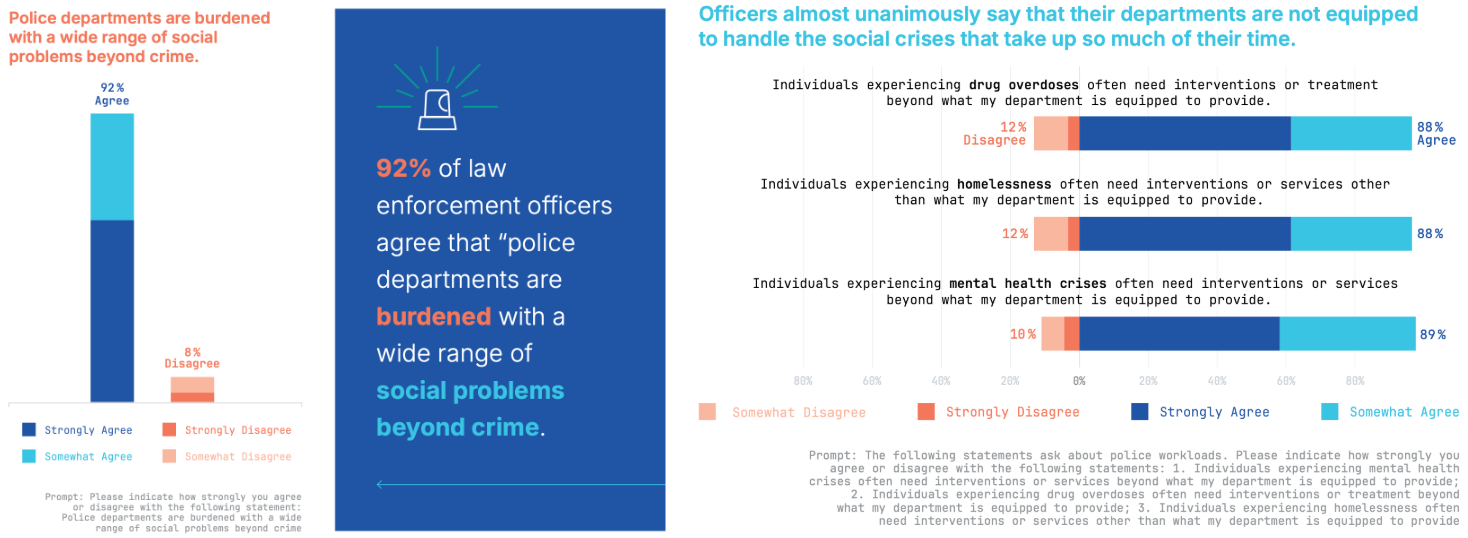
- 92% Of Law Enforcement Officers Agree That “Police Departments Are Burdened With A Wide Range Of Social Problems Beyond Crime.” Researchers found that officers “almost unanimously say that their departments are not equipped to handle the social crises that take up so much of their time,” specifically that:
- “Nearly 2 out of 3 officers (64%) reported that their work involved people experiencing a mental health crisis a few times a week,”
- “A majority of law enforcement officers deal with people experiencing homelessness on at least a weekly basis.”
- “One in six deal with suicide attempts on a weekly basis or more frequently, and one out of three deal with people experiencing drug overdoses weekly.”
- “Almost 90% of law enforcement officers agree – and a majority strongly agree – that the needs of people experiencing drug overdoses, homelessness, and mental health crises outstrip what their departments are equipped or able to provide.”
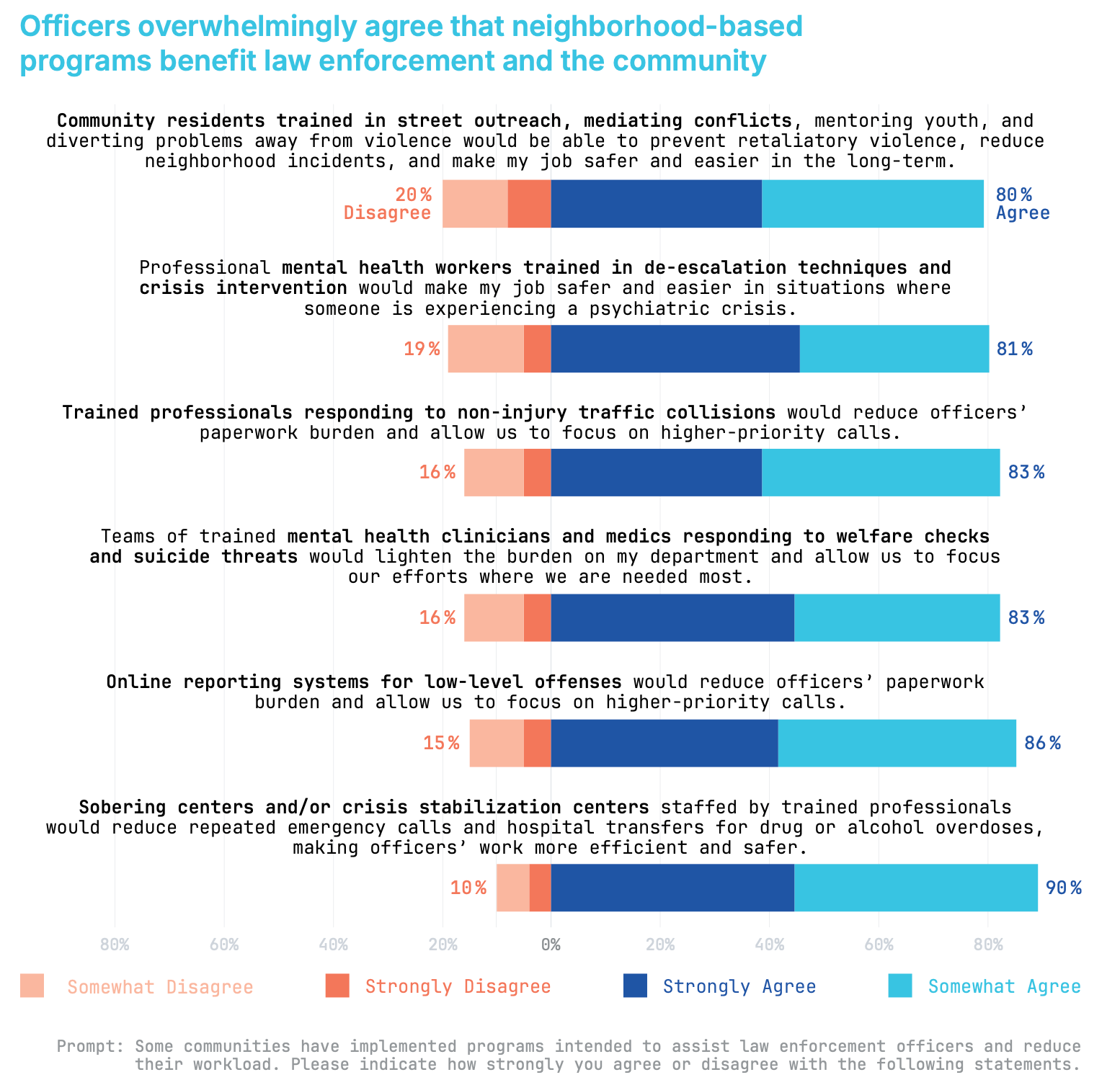
- 83% Agree That “Teams Of Trained Mental Health Clinicians … Would Lighten The Burden On My Department And Allow Us To Focus Our Efforts Where We Are Needed Most.” Researchers found widespread agreement that clinician-led response teams help officers return to other duties more quickly while ensuring people in crisis receive more appropriate care and services. The report found many officers viewed co-response and clinician-led models as improving both officer safety and community outcomes.
- 90% Agree That “Sobering Centers And/Or Crisis Stabilization Centers… Would Reduce Repeated Emergency Calls And Hospital Transfers [] Making Officers’ Work More Efficient And Safer.” Researchers concluded that officers increasingly see stabilization infrastructure as an important alternative to repeated ER visits, jail bookings, and recurring emergency calls tied to behavioral health crises.
- 81% Agree That “Professional Mental Health Workers Trained In De-Escalation Techniques And Crisis Intervention Would Make Their Job Safer And Easier…” The report found that officers overwhelmingly believe clinicians bring specialized crisis-intervention skills that help “make people feel at ease,” improve decision-making during emergencies, and connect people to appropriate treatment instead of the justice system.
- 80% Agree That Experts “Trained In Street Outreach, Mediating Conflicts, Mentoring Youth … [Would] Make Their Job Safer And Easier In The Long Term.” Researchers said officers increasingly view outreach teams as part of a broader “public safety ecosystem” capable of preventing crises from escalating into violence or repeat calls for service. Former Dallas Police Chief Reneé Hall said: “we cannot arrest our way to public safety… We need partnerships.”