A new implementation toolkit from Northwell Health’s Center for Gun Violence Prevention—developed with support from the Joyce Foundation and informed by health practitioners around the country—lays out a comprehensive framework for how hospitals can address firearm injury as a public health crisis. The toolkit draws on “years of collaboration with hospitals and health systems… clinicians, researchers, public health leaders” and incorporates research, surveys, and real-world implementation experience to map what works in practice.
Designed as an “implementation-focused roadmap,” the toolkit outlines system-, community-, and clinical-level strategies to help hospitals move “from aspiration to sustainable, coordinated action.” Within that broader framework, the report makes clear that hospital-based violence intervention programs are a central, evidence-based strategy—positioned alongside screening, counseling, and other prevention strategies as core clinical tools health systems should deploy to reduce repeat injury and save lives. The full toolkit is worth your time, but here are some toplines:
- Hospital-Based Programs Are Core Clinical Infrastructure: The toolkit places hospital-based violence intervention programs within “clinical and organizational-level strategies,” emphasizing that hospitals must “integrate firearm injury prevention into the fabric of healthcare delivery.” It identifies HVIPs alongside “screening and counseling… suicide prevention… [and] safe storage education” as core internal actions—making clear these are standard care functions, not optional programs.
- What Works: Coordinated Systems, Leadership Buy-In, And Long-Term Infrastructure: The toolkit highlights the need for “coordinated case identification and referral pathways,” shared data systems, and cross-sector collaboration to make hospital-based violence intervention programs effective. It calls for “engaging executive leadership… empowering champions [of these programs],” and building “internal governance structures” so programs can scale, alongside a focus on “evaluation, sustainability, and scaling” to embed these efforts systemwide.
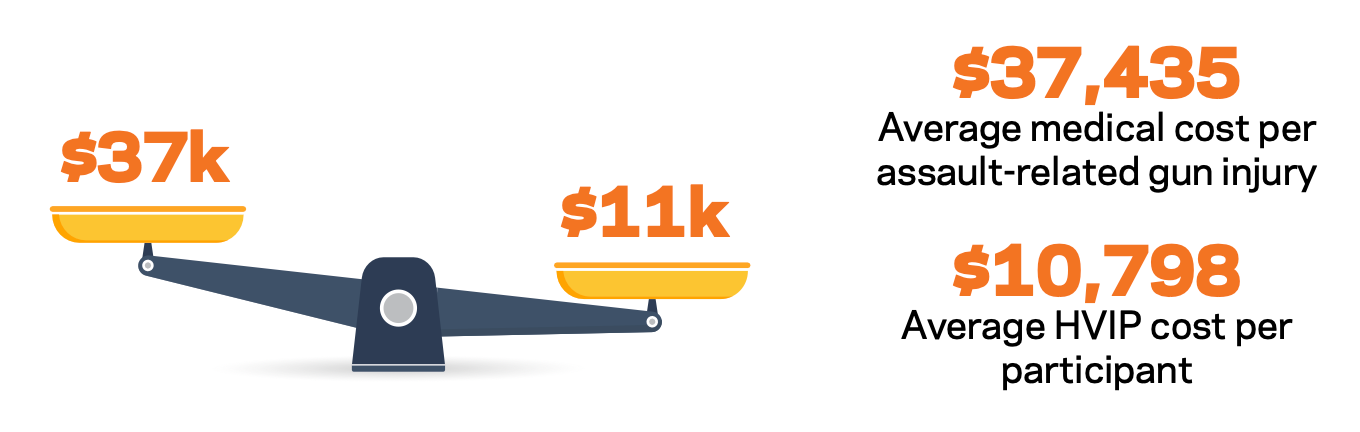
- Programs Fail When They Aren’t Built To Last: The toolkit makes clear that “implementation remains the critical gap… evidence alone is not enough” without plans for “scaling, sustainability, and overcoming real-world barriers.” It warns that many HVIPs have historically depended on “short-term grants, philanthropy, or patchwork state allocations,” causing instability in staffing and services. The toolkit argues for durable funding and infrastructure to build long-term impact. The toolkit also provides a helpful cost analysis: the average medical cost per gun-related injury is $37,435, compared to roughly $10,798 per HVIP participant—highlighting the potential for substantial savings if HVIPs were adopted in hospitals around the country.
Momentum For Hospital-Based Violence Intervention Programs, Around The Country:
- Hartford, Connecticut, Hospital Expands HVIP, Incorporating Proven Therapies Like “Somatic… EMDR, Cognitive Behavioral, And Brainspotting.” For Patch, Michael Lemanski reports on Saint Francis Hospital’s expansion of its long-running and successful hospital-based violence intervention program, that local leaders joined by Senator Richard Blumenthal, a vocal supporter of HVIPs, said would “improve access to timely care, reduce barriers to treatment, and strengthen long-term recovery for individuals and families affected by violence.” The expanded program “will incorporate somatic therapy alongside established clinical treatments such as Eye Movement Desensitization and Reprocessing (EMDR), Trauma-Focused Cognitive Behavioral Therapy and Brainspotting… [that can] address both the psychological and physical effects of trauma, including post-traumatic stress, anxiety, and depression.”
- In San Bernardino, California, HVIP Expanding “To Provide New Services To Address Unemployment And Mental Health” Services. Loma Linda University Hospital, which houses the region’s hospital-based violence intervention program, announced that the program is receiving a $4.7 million expansion to “provide new services to address unemployment and mental health, which are significant individual and societal risk factors for violent injury… including workforce readiness seminars with job interview coaching and job referral pathways, as well as counseling services and transportation or meal vouchers… [as well as] tattoo removal… a key part of workforce readiness and the only service of its kind in the Inland Empire.”
The university said that the hospital-based program has “served over 1,500 patients over the last three years… helping patients and families of those who sustain a violent injury, such as injury from gunshots or stabbings, modify circumstances and address social needs that can help break the cycle of violence… [using] a multidisciplinary approach with [health professionals] specialized in violence intervention and prevention and trusted community-based partners to provide safety planning, services, and trauma-informed care to violently injured people.”
- In Mobile, Alabama, HVIP Program Expands Reach Through Community Violence Intervention Team. For Fox News, Daeshen Smith reports on Mobile’s University Hospital HALO program, a hospital-based violence intervention program that has shown early promise providing wraparound care and services to gunshot victims as soon as they reach the hospital and then in the days and weeks that follow treatment, is expanding with a community violence intervention team “to spot the warning signs of violence and connect people to help before [violence erupts].” The hospital violence intervention unit is beginning training of the community team this month.