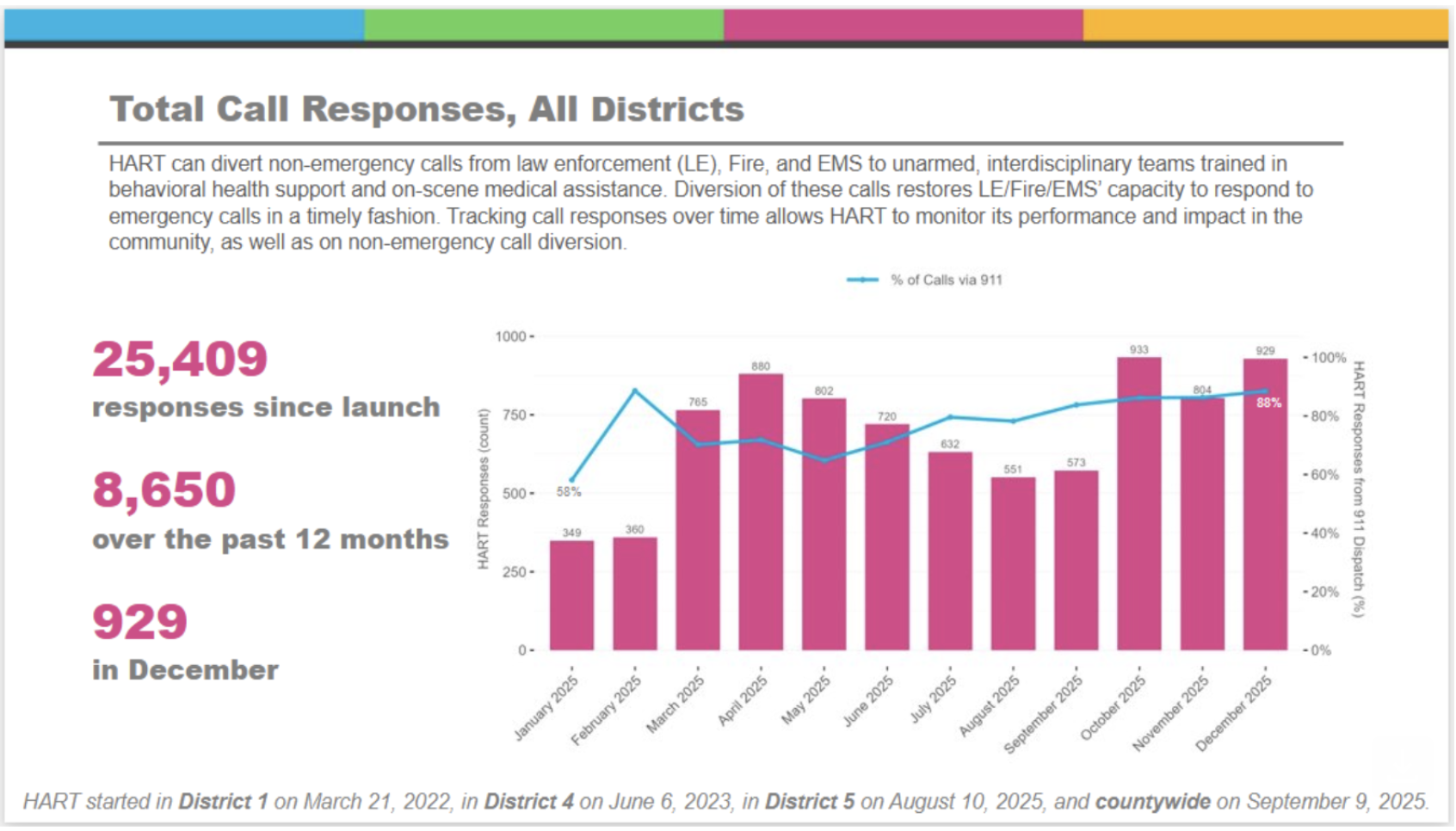
- In Harris County, Texas, HART Mobile Crisis Responders Mark Major Milestone—Exceeding 25,000 Calls For Service. For Harris One, Harris County Commissioner Rodney Ellis announced last week that the county’s Holistic Assistance Response Team, or HART—a mobile crisis response team that “dispatches healthcare experts, crisis specialists, and other medical professionals to handle some 911 calls involving mental health, behavioral health, and homelessness”—surpassed 25,000 calls for service in December.
Commissioner Ellis, a long-standing champion of HART who first launched the team in his precinct, also noted that 88% of the team’s calls came directly from 911, “meaning the team is meaningfully reducing the burden on other emergency service providers in fire, EMS, and law enforcement, who would otherwise have taken these calls, and increasing [other first response] capacity in turn.” Here’s a look at the county’s data on the team:
- The HART team first launched in 2022 as a pilot that responded to some emergency calls for service in Commissioner Ellis’s precinct. In the years since, the team has grown to “nearly 21 field-ready teams” who now respond to calls across the county, as well as a standalone hotline “offering a direct connection to the team” for residents in crisis. Here’s what local leaders are saying about HART’s role in the public safety infrastructure in Harris County:
- Harris County Sheriff’s Department Chief Mike Lee: Even in its first year in operation as a pilot, HART had already “‘freed up [hundreds of] hours of law enforcement time to respond to other calls… Officers still today find themselves in situations where they are nonstop dealing with calls in which the primary issue is poverty, lack of financial resources, substance abuse and addiction and mental illness. And I can tell you, police officers, although we are very proud of the training we have done, we’re not the best equipped to handle that, and we acknowledge that that’s not what our primary role should be,’” Chief Lee explained to the Houston Chronicle.
- Harris County Precinct One Commissioner Rodney Ellis: “This is about which expert should respond to a 911 call, and in the past, we’ve asked too much of our friends in law enforcement when it comes to 911 calls for people experiencing a crisis or struggling with health issues and homelessness. When it’s a robbery in progress, or a shooting, then obviously we need to send an armed sheriff’s deputy. But if we are talking about a person sleeping on a sidewalk, or a teenager who is suicidal and swallowed pills, then we need a behavioral health expert to respond. That’s the kind of crucial work that HART’s crisis intervention specialists do every day, and this is what it looks like to fully fund public safety in Harris County—we’ve got law enforcement, we’ve got mobile crisis response, and we’ve got community violence intervention. We are sending the right experts to solve the right problems.”
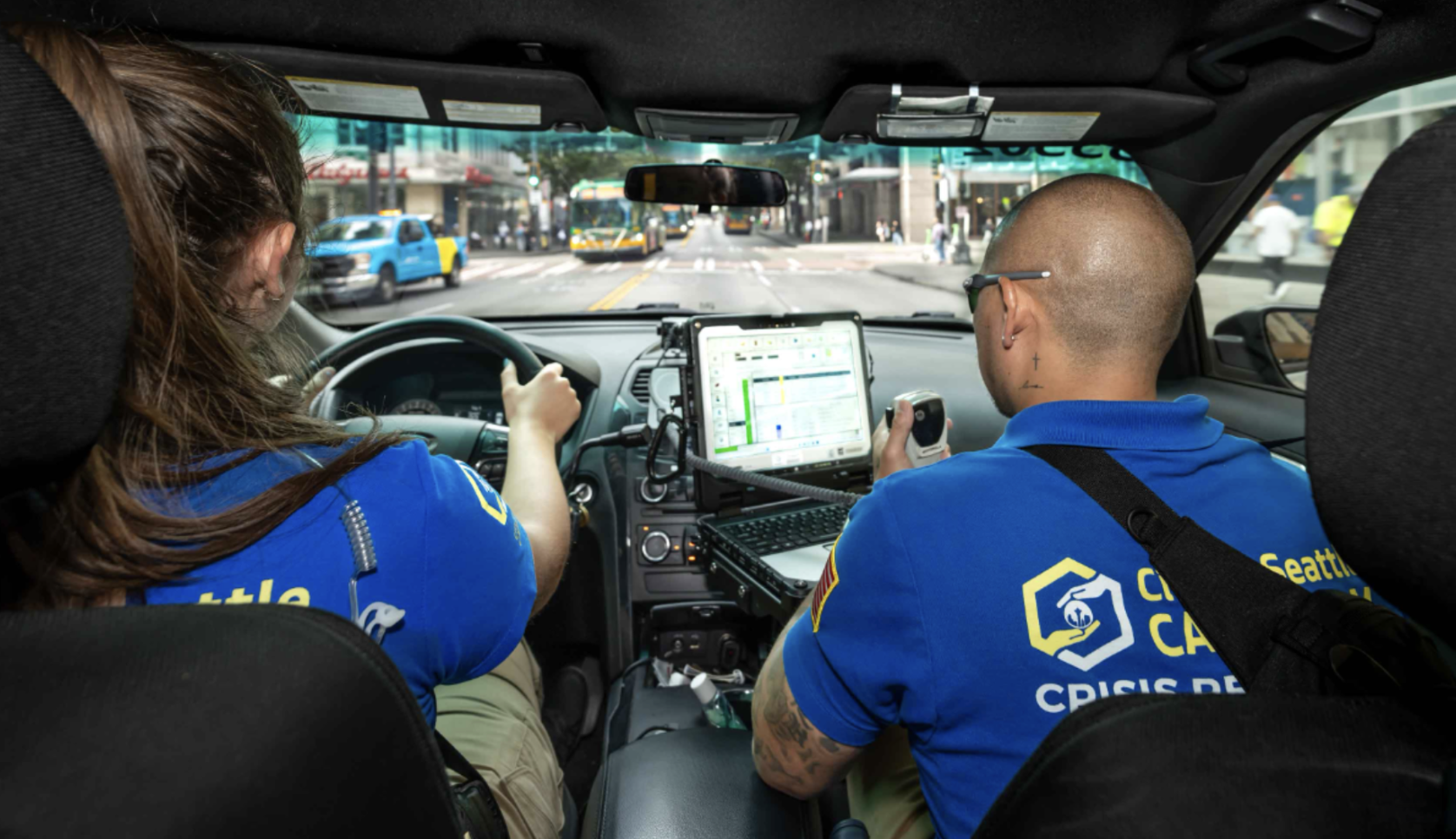
- In Seattle, City Approves New “Permanent Expansion And Direct Dispatch” Of CARE Mobile Crisis Responder Team. Seattle announced last month that the Community Assisted Response and Engagement, or CARE—the city’s “third branch of public safety” co-equal to the city’s police and fire departments—will remove the team size cap from its previous contract. Now, the new contract that the mayor advanced “allows for permanent expansion and direct dispatch of the CARE department’s crisis responder teams.” The move, the mayor said, “marks a significant milestone for efforts to diversify emergency response options.” The expansion of the team will begin immediately, with the budget already approved to “double the number of CARE Community Crisis Responders… as well as supervisors, a new training manager, and additional equipment,” as well as “expanding the types of incidents [the team] can be dispatched to, and authorizes [the team] to be solo dispatched” to some 911 calls for service.