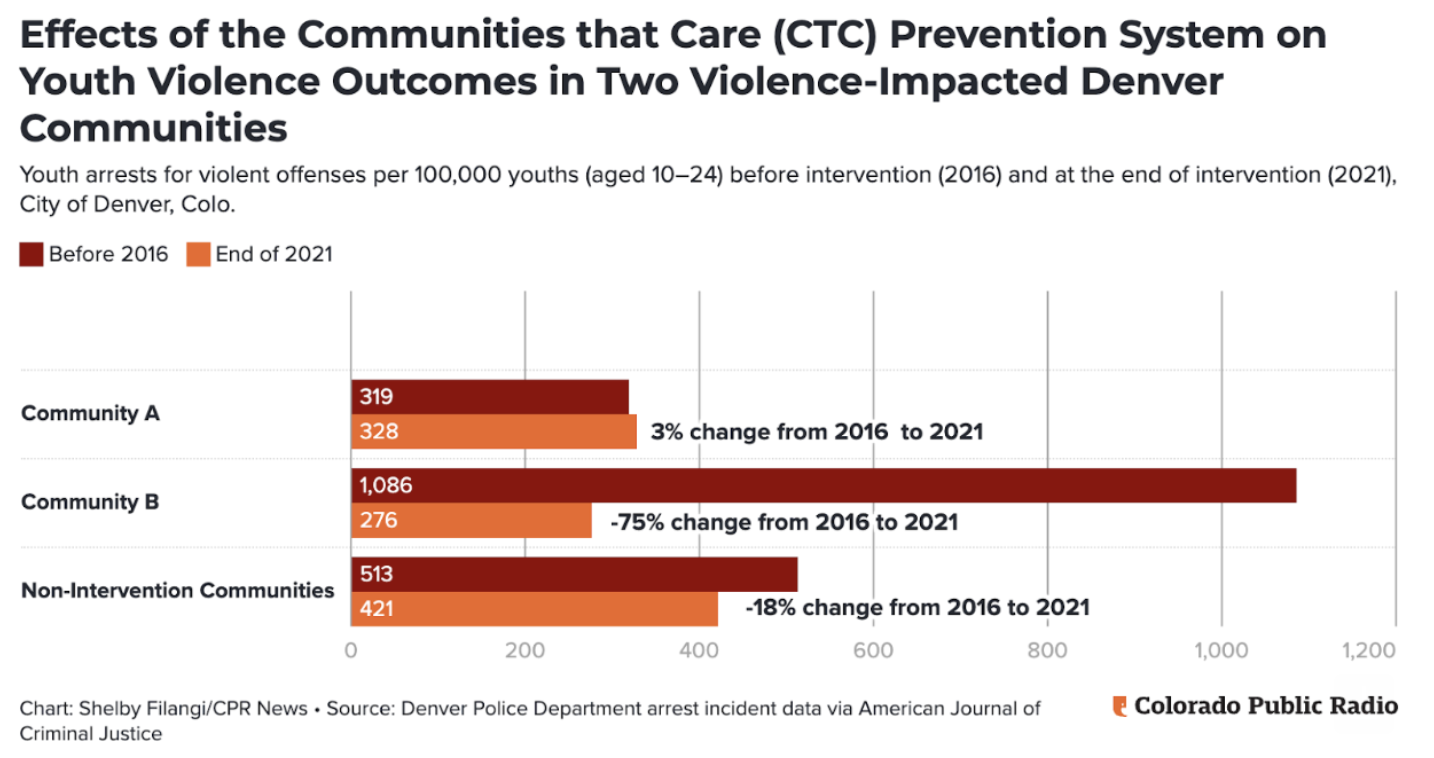
- In One Denver Neighborhood, CVI Program Helped Fuel A “75 Percent Decrease In Youth Arrests For Violence.” For Colorado Public Radio, Kiara DeMare and Arlo Pérez Esquivel report on a CVI program in the Park Hill neighborhood of Denver, where “a decade ago, youth arrests for violent offenses were high compared to the national average,” but saw “a 75 percent decrease in youth arrests for violence” from 2016 to 2021, when the CVI program was operational in the neighborhood. The CVI program was multi-faceted, the news station notes, it focused on both a concerted effort to “connect teens to their neighborhood… [forging a feeling of being] bonded to your community [which] can be a protective factor” and a partnership with “doctors and other medical staff serving the neighborhood to start using a standardized screening tool to identify the youth most at risk of violence.”
- In Detroit, A “50% Drop In Violent Crime In Some CVI Zones.” For Fox News, Hilary Golston and Jack Nissen report on the city’s CVI teams “press[ing] down on the city’s crime rates, showing the strategy of targeting potential sources of violence before they break out is working.” Between May and July of this year, the city’s seven CVI zones (each zone “covers approximately 3.5 to 4.5 square miles”) reported back “a 30% drop in homicides and non-fatal shootings” and “two areas on Detroit’s west side” saw “a 50% reduction across the same metrics.” As Fox notes, “while police are key to stopping crime, this program prevents it from happening in the first place… ‘law enforcement responds after the fact. What these groups are doing is getting in there before anything happens…’”
- In Chicago, CVI “Program Participants Earn High School Diplomas.” For CBS News, Jason Cooper reports on a group of young people “working to turn their lives around” through participating in Chicago CVI program, known as CRED, earned their high school diplomas, last week. The community violence intervention program that includes comprehensive wrap-around services, also helps its participants to complete their education. The news station noted that CRED staff members “helped the new grads earn their [high school] diplomas” with “family members, life coaches, and outreach workers all there to cheer on the graduates.” Since the CRED program was first founded 2016, it has helped 400 participants [to earn] high school diplomas.”
A recent study from a team of researchers from Northwestern University examined the outcomes of 324 men who participated in the Chicago CRED program, between 2016 and 2021, and found that the men who completed the full 24-month CRED program were “more than 73% less likely to have an arrest for a violent crime in the two years following enrollment compared to individuals who did not participate.”