A new working paper published in the National Bureau of Economic Research evaluates the impact of the mobile crisis response program by examining a program that had been running in Eugene, Oregon, which dispatched unarmed mental health professionals to 911 calls involving behavioral health and social crises.
Researchers concluded that the program “reduced the likelihood that a call resulted in an arrest… [due to the team’s] role in de-escalating tense situations and resolving incidents without coercive measures…[and that] crisis response teams play an important role as a complement to the police” in a city’s public safety infrastructure. The full report is worth your time, but here are three key takeaways:
- Expands Access To Mental Health And Emergency Services: “[The] team responds to mental health, substance use, and housing-related [calls, and] … treats them as health and social problems [and]…increased access to medical services…[The program also] leads to [an] increase in the probability that [for example] a cardiac arrest is identified and an increase in the probability that an individual is transported to the ER…”
- Reduces Repeat 911 Calls: “We find that [the team] are used mostly for calls that would otherwise go unanswered… [and] expands access to other city services and appears to be effective… decreasing the likelihood of a subsequent call from the same address over the next several weeks…”
- Mobile Crisis Fills In The Gaps: “The behavioral health calls eligible for [the team] make up a growing share of public safety responses but police often lack the training or mandate to respond effectively…we find that [the program] reduced the likelihood that a 911 call resulted in an arrest…[when these teams] are most often … acting as a supplement rather than a substitute…”
More Mobile Crisis Response Teams Expanding:
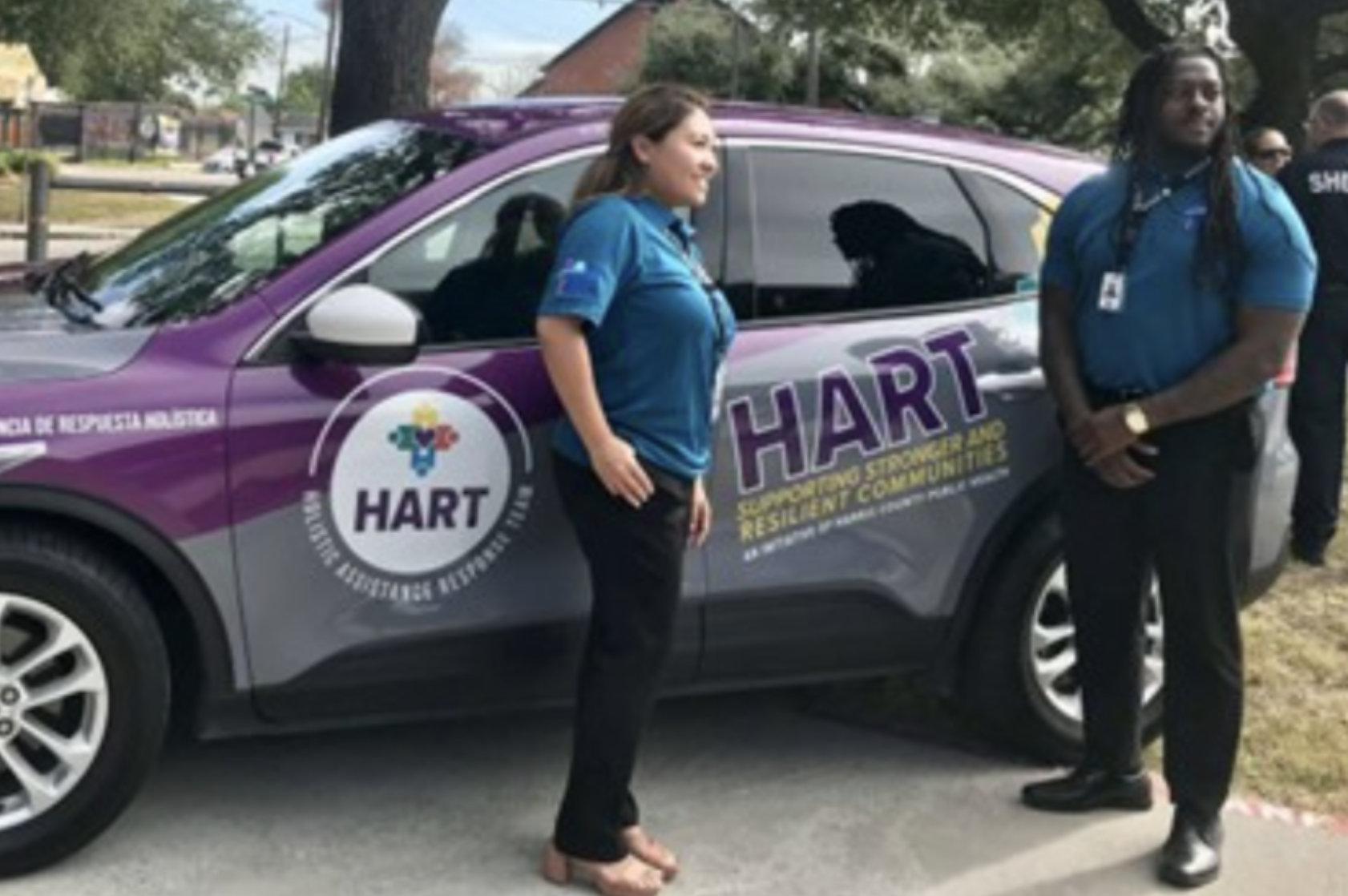
- In Harris County, Texas, Commissioners Expand The Holistic Assistance Response Team “Across The County.” For Houston Public Media, Gabrielle Dawkins reports on County Commissioners voting this week to “approve new staff positions for the county’s Holistic Assistance Response Team, or HART, which will expand the program to serve all parts of unincorporated Harris County… including Houston.” The much-lauded HART team—composed of “11 teams, each composed of one crisis intervention specialist and one licensed EMT”—has already “responded to more than 20,000 mental health-related 911 calls” since it first launched in 2022.
Commissioner Rodney Ellis, who spearheaded the creation of the HART program, explained to the news station that “HART is getting people the help they need when they need it most, decreasing our jail population, helping clear court back logs and lessening the DA’s case logs, freeing up time for law enforcement and EMS for true public safety and medical emergencies which they are better equipped to handle.” Commissioner Lesley Briones, a champion of the HART program, added that the team is “connecting people to the support they need, not booking them in our already overcrowded jail.”
- In Long Beach, California, City Leaders Expand Community Crisis Response Team Citywide. For The Signal Tribune, Samantha Diaz reports on the expansion of the city’s CCR team, which responds to “mental health calls that would otherwise go to police… [which, since 2023, has] been focused on downtown and West Long Beach … but will now serve the entire city.” The team—composed of a crisis intervention specialist, nurse, and peer navigator, program manager and supervisor—when responding to a call for service, “assess the person’s mental, physical and social needs at the moment and develop a plan… solutions typically consist of on-scene support, connections to services, referrals to services and/or transportation to additional [medical, shelter, and emergency] services.”
- Idaho Expands “Crisis Response With 24/7 Mobile Teams Statewide.” For News6, Keith Burrell reports on state leaders sweeping mental health expansion across the state, providing “24/7 access to behavioral health teams that can come directly to them during a crisis.” The expansion follows several successful mobile crisis teams responding to mental health calls for service, like the team operating in rural Washington County, which has helped “free up resources for ambulances and law enforcement,” the Idaho Capital Sun reported.
Ashley Lynn, a veteran paramedic who leads the team, explained to the newspaper that “the two worst places for someone in crisis to go is the hospital and jail… this program [allows us] to be able to bypass those destinations [and] get someone right into whatever service is going to best serve their needs… [that way] they’re not accruing emergency room or ambulance bills… they’re not occupying a seat unnecessarily in the jail, and they’re actually getting help and maybe changing the trajectory to where they can get better.”