| In a study published in the peer-reviewed journal AIMS Public Health, researchers at UCLA and the University of Michigan examined 12 peer-reviewed articles evaluating Trauma Recovery Centers in three U.S. locations—San Francisco, Long Beach, and Cleveland—focusing on how these centers serve victims of violent crime. Researchers found that trauma recovery centers show “promising results for treatment engagement and improvement in psychological and social needs,” with particularly meaningful outcomes for mental health: “Victims of crime who complete at least nine sessions of evidence-based psychotherapy show improvement in psychological symptoms related to PTSD and anxiety” and are “less likely to experience injury recidivism.” Here are the main findings:Trauma Recovery Centers Dramatically Boost Access to Care: “Access rates range from 55.7% to 72.3%… [and] treatment initiation rates range from 44.0% to 72.0%… [by contrast] other models of care for victims of crime demonstrate rates of treatment initiation as low as 3% … and [only] as high as 14.7% … The rates of treatment access and initiation for victims of crime referred to TRC services are higher than those referred to non-TRC victim services.”Mental Health Outcomes Improve—Significantly: “Individuals who complete mental health sessions show improvement in PTSD, anxiety, and depression measures… [For example, patients who] meet criteria for PTSD: 72.6% at session one vs. 32.2% at session nine… meet criteria for depression: 68.6% vs. 41.6%… meet criteria for anxiety: 68.3% vs. 46.1%… [and upon treatment completion] “are less likely to experience injury recidivism.”TRC Services Lead To Better Outcomes Beyond Mental Health: “Assignment to TRC services… mitigated reductions in application for victim compensation in individuals who were ≤ 35 years, had less than a high school education, or were homeless… 55.9% of those randomized to TRC services filed victim compensation claims… [compared to just] 23.0%… receiving usual care… [Of those who filed claims] 78.3% of those receiving TRC services successfully received compensation [versus] 91.5% of those receiving usual care…”Related: Another paper published last month by researchers at Johns Hopkins University on Trauma Recovery Centers found that the model has proven to “provide comprehensive mental health and case management services to all survivors of violence.” The full paper is worth reading, but here is a spotlight on a vignette from a patient whose recovery was made possible through a trauma recovery center: |
| “A 20-year-old Spanish-speaking woman is the victim of a home invasion and sustains a stab wound to her leg. She calls 911 and is transported to a hospital. Her stab wound is complicated and will require a specialist. She is discharged from the emergency department to follow up as an outpatient… …At home, she becomes intensely afraid. She experiences flashbacks of the home invasion. She is unable to sleep, and her anxiety prevents her from leaving the house. She misses her follow-up appointment due to lack of transportation to the specialist an hour away; she is unable to work due to her injury. Her life seems to be spiraling out of control. A friend becomes worried and brings her back to the emergency department to ask what can be done [and is referred to a TRC]…“…[a] TRC representative arrived at the [ER] bedside to … explain the TRC services, and answer questions. The patient enrolled in both therapy and wraparound case management services. The case manager supported her through conversations with the police and helped her apply for victims’ compensation funds for relocation. The therapist begins working to address her post-traumatic stress disorder symptoms. With the support of the TRC and assistance with transportation options, she can overcome her anxiety enough to engage in her medical care including physical therapy to regain strength. Encouraged by the progress, she completes therapy and, eventually, she can walk steadily and is cleared to return to work…” |
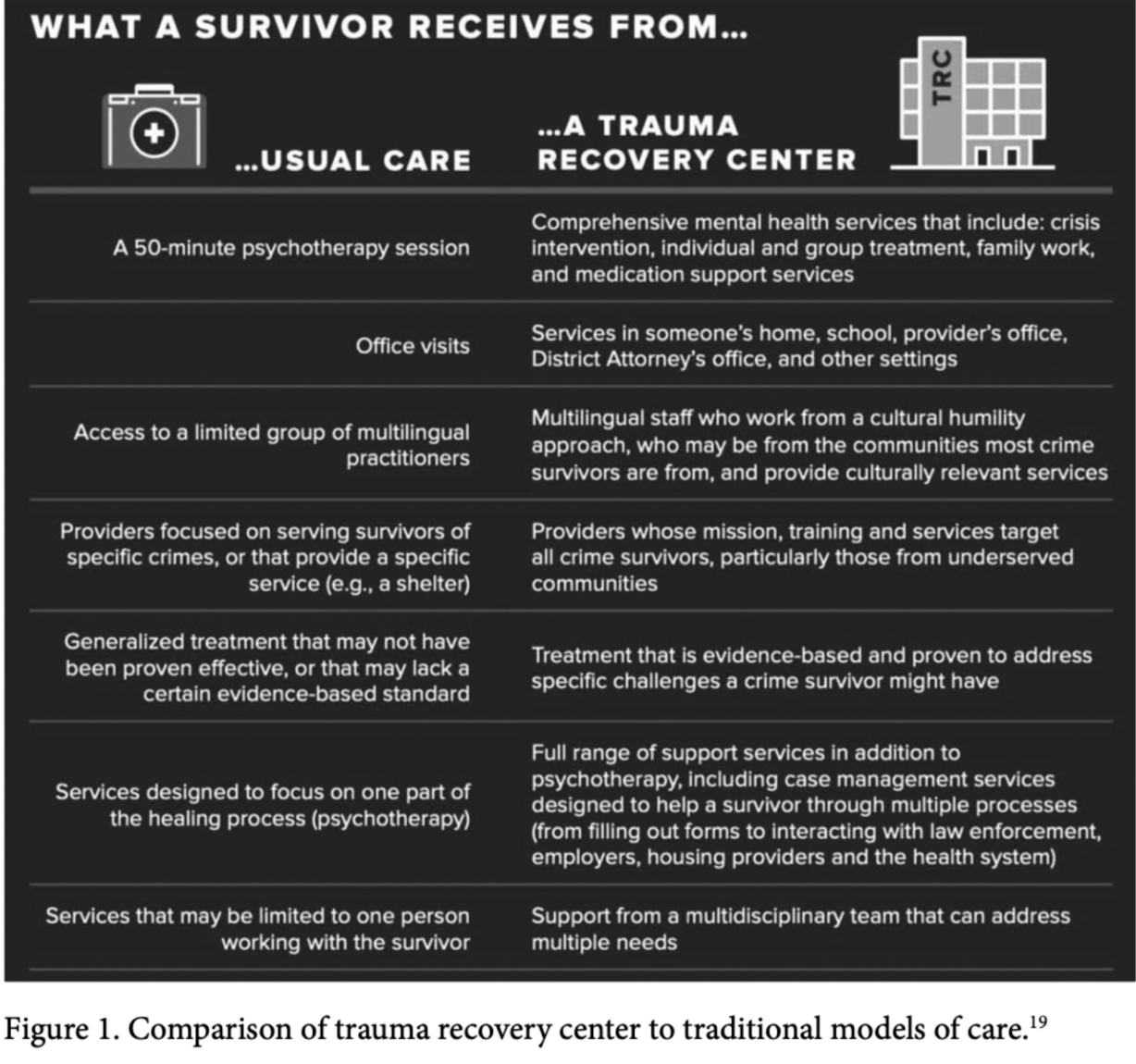
| The study also includes a handy infographic about the difference in services from a traditional model versus a Trauma Recovery Center: |
 |
| More Trauma Recovery Centers Opening Around The Country:In Arizona, New Trauma Recovery Center Launching For Victims Of Sex Crimes. For KJZZ, Nick Karmia reports on a $60 million recovery center “set to break ground in Glendale… a major step forward in long-term, trauma-informed care.” The facility will “provide 170 beds, including 120 for youths in intensive behavioral health recovery and 50 for survivors facing chronic physical conditions.”In Kentucky, New Recovery Center Opens In Louisville. For WLKY, Joyce Ogirri reports on the new “state-of-the-art recovery center opening its doors to survivors of “human trafficking and trauma.” The center, “designed for both men and women, offers a comprehensive range of services, including therapy, life coaching, and job readiness training” as well as “addiction recovery, meals, shelter space and much more.” In Brooklyn, New Center Opens To Help Domestic Violence Survivors. For News12, Rob Flaks reports on a new center opening in Flatbush, a location chosen “due to its [frequent] domestic violence calls and reported violence cases…” The new facility has “therapy rooms, a remote appointment space and child room… [and is] designed to help victims of violent crimes overcome barriers to accessing mental health treatment, health care, and legal resources in the acute aftermath of trauma…” |