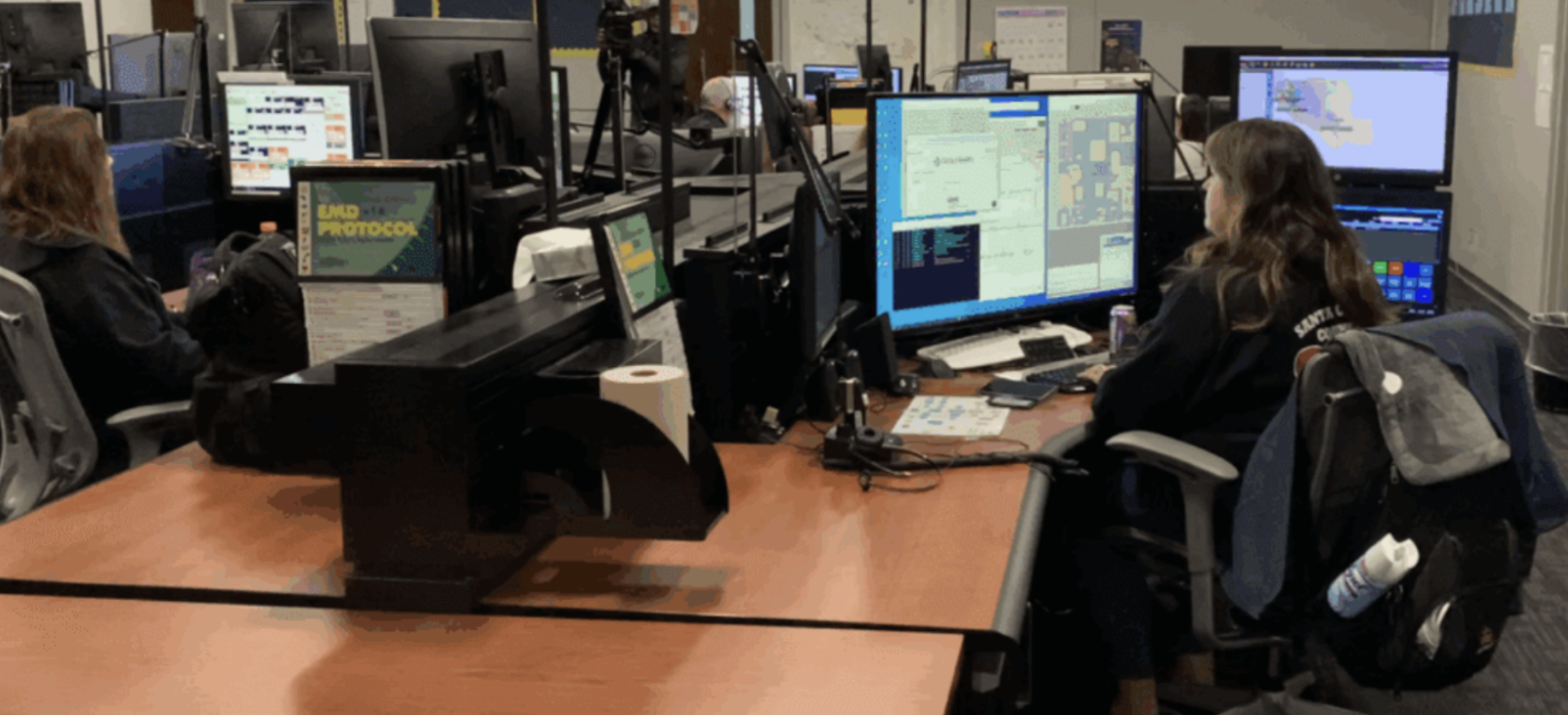
- In Missouri’s Springfield-Green County, Mental Health “Crisis Specialist To Now Work Inside 911 Full-Time.” For The Springfield News-Leader, Marta Mieze reports on county leaders bringing more mental health expertise into the Springfield-Green County’s 911 emergency dispatch center “to more effectively address mental health crisis 911 calls” in the region by “decreas[ing] the number of responses from police to individuals who are experiencing mental health crises” and dividing those calls to trained mental health experts instead.
April Ford, who oversees the county’s 911 dispatch center, explained that the integration “helps each team to communicate better, learn how each person is trained, how calls to each agency can differ and to better understand the crisis specialists’ skills in action…. not all callers want a law enforcement response and [some] may [instead] need resources or to speak with a 988 crisis specialist to assist with mental health needs.” Ford, who also sits on the statewide 911 Service Board Training Committee, said that experts from around the county and state “collaborated on training and setting up procedures to make the integration work… [so that] the 988 crisis specialist can help not only with calls on site, they are also able to engage with the 911 team about available resources that they previously were not aware of [and the county’s] crisis team will relocate additional [mental health] team members to the 911 center as needs arise.” - In Colorado, Colorado Springs Now “Allowing Dispatchers To Connect Callers Directly With The Mental Health Hotline.” For The Colorado Springs Gazette, Grace Brajkovich reports on a new partnership with 988 in the county which “provides the Colorado Springs community with more mental health resources in moments of crisis.” A spokesperson for the Colorado Springs Police Department, who oversees the 911 dispatch center, explained to the newspaper that “a lot of (mental health related) callers just need someone to talk to. We often send an officer out to provide them with the resources they need…. [but] sometimes when you are experiencing a mental health crisis, you don’t always want to talk to the police. That isn’t always the most appropriate option.” The new agreement will allow “non-emergency callers [to] be referred to 988… [and if needed] the Community Response Team will provide emergency mental health care for those in need of immediate attention.”
- In Florida, New Law Includes “988 Helpline In The State’s Panoply Of Mental Health Services.” For Florida Politics, A.G. Gancarski reports on Governor Ron DeSantis signing into law House Bill 1091 which provides the mental health hotline with “statewide interoperability with the 911 system and to provide individuals with rapid and direct access to the appropriate care.” The bill officially adds the mental health hotline as part of the state’s public safety infrastructure which includes “mobile response teams, crisis stabilization units, addiction receiving facilities, and detoxification facilities” and will help ensure standardization around “service delivery, quality control standards, training and certification for staff members” statewide.
Related: Los Angeles County launched a new centralized dispatch center that targets people experiencing homelessness to “to quickly connect [them] with housing,” Kahani Malhotra reports for LAist. The Emergency Centralized Response Center, or ECRC, “centralizes intake to the various services and programs for unhoused individuals run by a host of county and city departments, agencies and outreach teams.” Before the centralized dispatch was created, the county “would have all of these outreach teams descending upon this one site, which is not a good use of resources… [but now as a] centralized information hub, officials say the dispatch center can coordinate across several agencies and teams to receive requests for services and direct a group of 150 outreach teams to help provide timely interim housing and necessary support.”