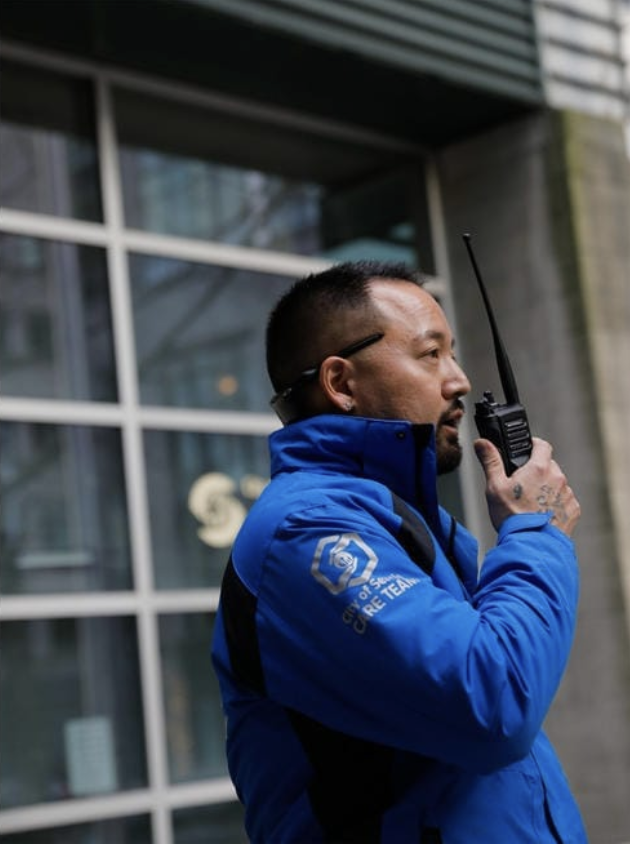
- In Seattle, Washington, “the city’s 911 dispatchers are now directing a team of mental health professionals,” known as the Community Engagement and Response (or, CARE) team, to help “people on the street who need supplies, referrals to resources, transport or just someone to listen,” as Liz Radel reports for KUOR, Seattle’s NPR station. Here are two examples that already demonstrate the value of the CARE team’s work:
- “Temperatures were dropping and most shelters were already full” when the CARE team encountered “an individual who was looking to get into shelter.” Chris Inaba, a member of the CARE team, told NRP that he and his partner “contacted our resources, and we were able to find the person a bed, and then we provided the transport as well.”
- As Nimra Ahmad reports for Seattle’s local PBS station, the CARE team also helped a 70 year-old woman find shelter after she was evicted from an apartment building where she had lived with her husband for twenty years until he died the year before. The CARE team was “able to reserve a bed for her at the Downtown Emergency Service Center’s Crisis Solutions Center, but now came the hard part: convincing her to go.” Ahmad describes what happened next:
“For nearly three hours, [the CARE team] gave this woman their full attention. They attempted to connect her with a nearby storage unit where she could safely store her belongings now strewn across the alley, but, still in shock and completely focused on returning to her apartment, she refused the offer. They spoke with the building’s property manager to advocate for her, but to no avail. After a lot of negotiating and waiting patiently as the woman rummaged through her belongings to determine what she’d have to part ways with, they got her in the car, drove her to the Crisis Solutions Center and let a case manager take over. In the end, despite her initial resistance, she thanked the CARE Team.”
Right now, as Radel reported for NPR, the CARE team “is small, there’s a single team available from 11 a.m. to 11 p.m. each day and their response area is confined to the downtown core.” However, the plan is for CARE to expand throughout the city after it gains footing downtown.
Notably, one likely unnecessary friction to scaling the CARE program could be the city’s dual dispatch model in which 911 sends both the police department and the CARE team to calls. This dispatch model differs from most of the mobile crisis response programs highlighted in Safer Cities in that most programs dispatch only the mobile crisis response team and then allow those responders to request police back-up as needed. The downside of the dual response model is both that it expends police resources on calls that do not require a police response and that the presence of sirens and an armed officer can interfere with the successful resolution of a call for service.
- Santa Monica, California, also launched its mobile crisis response program, known as Therapeutic Transportation, which is a “specially trained team that will eventually be on call 24 hours a day to assist anyone in Santa Monica suffering from mental health-related trauma.” As Scott Snowden reports for the Santa Monica Daily Press, the “team will have the ability to do a psychiatric transport to an urgent mental healthcare facility or hospital, as well as impose a 72-hour psychiatric hospitalization for a person who is deemed to be a danger to themselves or others.” Two quotes from the Daily Press story that capture the aim of the city’s mobile crisis program:
- They “help people in our streets, [and] help reassure our residents that there is help on the way for those people that they are wary of and it will help people regain their lives … because what’s happening right now is in many cases, homeless individuals on our streets get emergency care or no care. And they have no real chance to regain their lives and become productive residents.” Santa Monica mayor Phil Brock.
- “Our hope is that we can intervene, when and where we can, rather than law enforcement or the fire department, so it frees up the resources for the city to divert to more severe emergencies.” L.A. County Department of Mental Health Director Lisa Wong.
- In Wayne County, Michigan, which encompasses the city of Detroit, “the Detroit Wayne Integrated Health Network is hitting the road with mobile crisis units this week in an effort to help local children and adults in crisis.” As Detroit’s local ABC affiliate explains, the program will launch with four teams and be “available Monday through Friday from 7 a.m. to 3 p.m. for adults only. Eventually, though, the group hopes to provide around-the-clock services for children and adults.” Right now, the program is not integrated into the 911 call center, but leaders hope that soon mobile crisis response will “be able to connect with 911 so they can be dispatched if people call with a crisis that doesn’t require a police response.”
In an interview with Kara Berg from Detroit News, the Vice President of Integrated Health Network, the organization that manages the mobile crisis program, highlighted three features of the program that county residents should know:- “Each team has a clinical social worker and a peer recovery coach with lived experience [and] the teams can go to someone’s home or meet them wherever they are as long as it’s in Wayne County.”
- “They can connect people to community resources they may need, such as shelters or food banks, or to outpatient mental health or substance abuse resources.”
- “They can also transport people to crisis stabilization units or hospitals if they need more care than the mobile units can provide.”