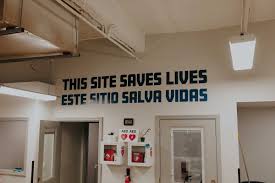
After New York City launched two of the country’s first overdose prevention sites—a space that provides people with a safe and supervised place to use drugs—researchers found that the centers were associated with both reduced overdose risk and decreased public drug use. Now, for The New York Times, Maia Szalavitz reports on a new study, published in the Journal of the American Medical Association, which finds that “violent and property crime rates near the two overdose prevention centers did not increase any more than crime in similar neighborhoods elsewhere in the city.” As Szalavitz writes, these findings “should ease fears surrounding overdose prevention centers…”
Here’s more detail from the study:
- “No significant changes were detected in violent crimes or property crimes recorded by police, 911 calls for crime or medical incidents, or 311 calls regarding drug use or unsanitary conditions observed in the vicinity of the OPCs.”
- “There was a significant decline in low-level drug enforcement, as reflected by a reduction in arrests for drug possession near the OPCs of 82.7% … and [by comparison] a reduction in their broader neighborhoods of 74.5% …”
- There were “significant declines in criminal court summonses issued in the immediate vicinity by 87.9% … and [by comparison] in the neighborhoods around the OPCs 59.7% [reductions] were observed…”
Here’s Szalavitz in the NYT on why these findings matter so much:
“One of the biggest misunderstandings about [overdose prevention centers] is that their nonjudgmental approach encourages increased drug use and delays abstinence or recovery…. [To the contrary,] this environment is critical to fostering more effective recovery from addiction … Research has consistently shown that approaches that prioritize public health over drug-law enforcement do not worsen neighborhoods or increase crime rates [or] lead to higher drug use among youths or people who are already addicted. [Instead, the public health approach] can increase the likelihood that they enter treatment. At least 200 such centers now exist in over a dozen countries around the world and not a single reported death inside a facility. The New York sites have been utilized over 90,000 times by around 4,000 people, with 1,100 overdoses reversed and no deaths.”
Related: These facilities are variously named safe injection sites, safe consumption sites, or overdose prevention centers. Safer Cities conducted a national survey of likely voters last year and found that the naming matters a lot: Calling these facilities “overdose prevention centers” significantly increased support by 11 percentage points over “safe consumption sites” and 15 points over “safe injection sites.”