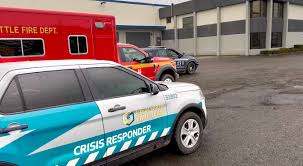
For The Seattle Times, Sarah Grace Taylor reports on Mayor Bruce Harrell’s announcement that the city will invest $26 million to establish the “Community Assisted Response and Engagement department” as “a new branch of the city’s public safety response—along with the police and fire departments.”
- The CARE Department aims to “improve public health and safety by unifying and aligning Seattle’s community-focused, non-police public safety investments to address behavioral health, substance abuse, and [other] low-risk calls for service through diversified programs that are equitable, innovative, evidence-based, and compassionate.” The department will have three divisions:
- “Emergency call takers and dispatchers in the 911 Center;
- “Community-focused public safety responders including behavioral health professionals;
- and violence intervention specialists.
- What Seattle’s leaders are saying about CARE:
- “Building on lessons learned locally and from around the country, we will build a stronger public safety system and a safer Seattle for all residents,” Mayor Bruce Harrell.
- “This could be a model for the country,” Police Chief Adrian Diaz.
- CARE will “deliver rapid civilian public health assistance to community members in crisis and frees up police to focus on preventing and solving crimes.” Councilmember Andrew Lewis.
- Seattle’s CARE Department is “modeled after the one in Albuquerque, N.M.,” as The Seattle Times reported. Launched in 2021, Albuquerque’s first-in-the-nation Community Safety Department houses the city’s mobile crisis response, violence intervention program, and street outreach responders program that assists people experiencing homelessness. And, like Seattle’s CARE Department, Albuquerque’s Community Safety Department has earned praise from the local leaders, including the police chief (“This innovative … third branch of public safety … provides residents with the response they deserve [and] frees up our officers so they can respond to high-priority calls.”) and the U.S. Attorney for the District of New Mexico (“hundreds, thousands of folks that are experiencing mental illness episodes and homelessness … [now] are greeted first by somebody who is not carrying a badge and gun, but instead by somebody who is equipped to handle their issues.”)
- Community Safety Departments Enjoy Overwhelming Bipartisan Support:
- Three-in-four voters nationally (75%) support “creating a community safety department that would function as a separate and coequal city department alongside the police and fire”;
- Nearly nine-in-ten voters nationally (89%) “strongly agree” that “community safety departments would make their city safer and free up the police to focus more resources on solving serious crimes.”
- A robust majority of voters nationally (62%) believe that unarmed civilian responders programs such as community violence intervention, security ambassadors, and mobile crisis response “should be part of one city department, which could be called a Community Safety Department.”
- Fact Sheet: Here’s a short-guide to community safety departments, which includes a more comprehensive list of the programs and services that fit under this centralized civilian first responder agency.