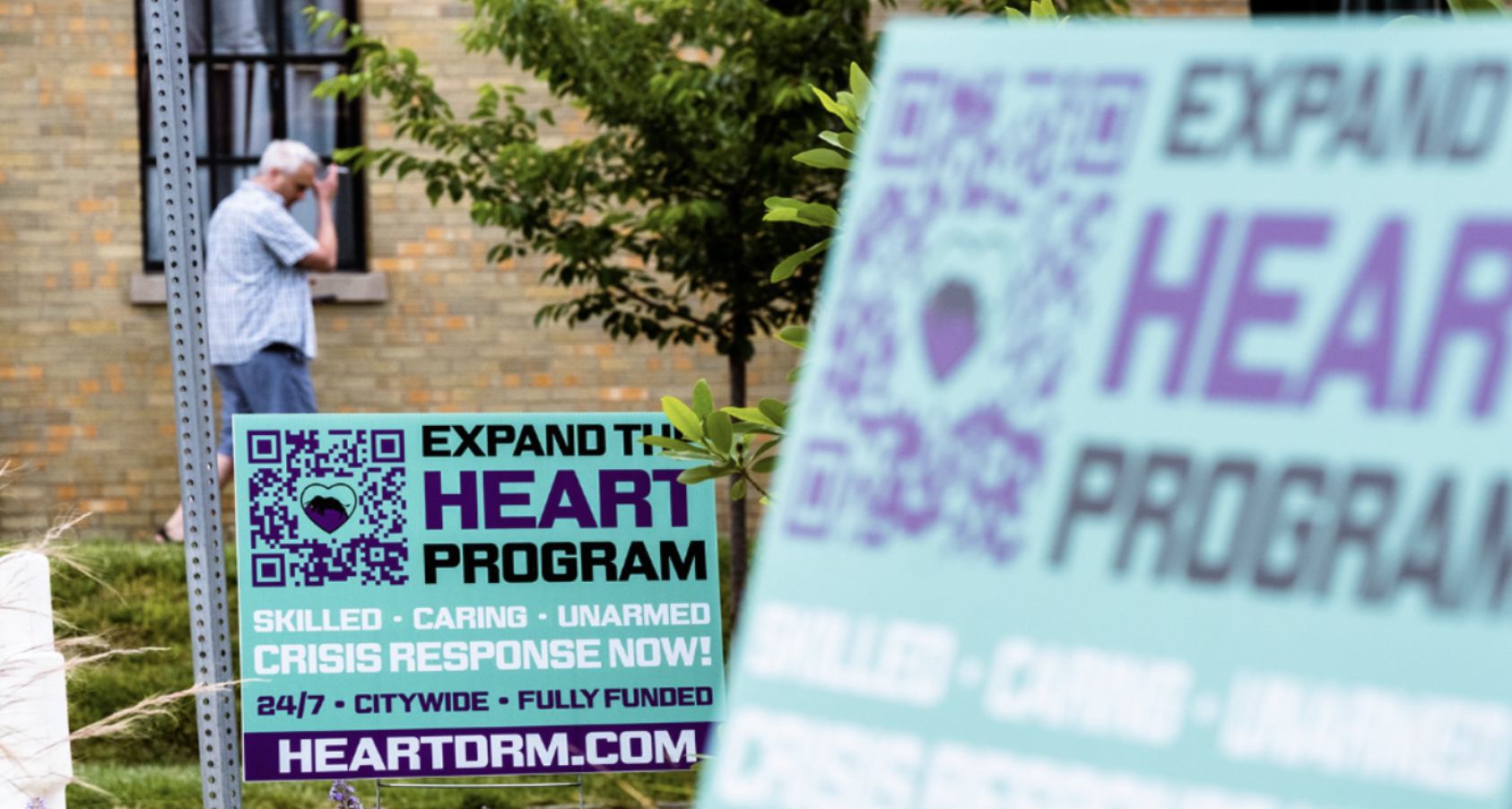
Durham, North Carolina’s local ABC affiliate produced an excellent investigative segment on the Durham City Council’s decision announcing an additional investment of “nearly $2 million into its Community Safety Department which just last summer launched as the first of its kind in North Carolina.” The program has already become so popular in the community that the program’s director told ABC news that the “neighbors that we serve [are] asking for more HEART [and the team is even] seeing yard signs and other outpouring[s] of support …”
As ABC reports:
“The department currently employs around 20 people who aim to assist and de-escalate 911 calls that relate to capacity outside of police officers’ training …. [Indeed], Ryan Smith, the director of the Community Safety Department, said the [HEART] team’s work has saved officers at least 1,500 hours this past year [and] data from the city reveal HEART responders have answered 6,500 calls since last summer.
Currently, the team operates in around a third of the city and has only been able to assist with about a fifth of the calls it receives. The additional funding will allow the pilot program to grow by 150% with 27 new openings. Fully staffed this will allow the service to expand citywide and be available 12 hours a day. The city aims to have the department handle 13,900 calls a year, which would account for 10% of the 911 calls the city receives.”
Related: Jeffrey Billman also published a terrific long-form piece on the Durham HEART program for The Assembly NC earlier this year. Here are a few excerpts that capture why Durham’s approach is worthy of attention from lawmakers who are considering building or expanding these programs anywhere in the country:
- An important insight into how HEART views its work and the mindset of people who the team would want to hire: For example, the team calls the people it interacts with “neighbors”, which the Public Safety Director said “was more deliberate. The common words that we hear often in this area are ‘clients’ or ‘consumers. None of those felt right to us. Someone brought forward the suggestion of ‘neighbor,’ and it just felt like it embodied the spirit of the work and how we want to be thinking about it … What many, maybe all of us, have experienced in life is, we’re walking downtown, we see someone in crisis and the instinct is to go to the other side of the street, stay away …. What we’re looking for are people who will draw near to people at that moment of crisis—that sense of physical proximity, of not othering or judging or being afraid. That, to me, is what is embodied by the term ‘neighbor.’”
- Durham views its program not simply as a mobile crisis response program, but as a community safety department with multiple functions that can grow and expand over time. Indeed, as Billman wrote in The Assembly NC, to “Durham’s Community Safety Director, Ryan Smith, [ the individual programs are] ‘pieces of a larger idea.’ So he and his team divided HEART into four segments: community response, which is the unarmed crisis teams; co-response, which pairs a police officer and mental health clinician; crisis call diversion, in which a clinician in the 911 center assesses mental health-related calls; and care navigation, which follows up with the people HEART teams encounter … Only Albuquerque, New Mexico’s program is as expansive.”
- Durham views its community safety department as the fourth branch of public safety. Here’s Durham Community Safety Director Ryan Smith: “We only had three buckets to put 911 calls: police, fire, and EMS. But there’s a whole bunch of other reasons people call 911. And a lot of those calls have historically been sorted into the police bucket …. A lot of those calls we can safely and appropriately respond to without sending law enforcement—without sending, you know, someone armed with a weapon.” Sorting out those buckets has meant that “HEART’s responders should take: suicide threats, welfare checks, public intoxication, behavioral health problems, and trespassing, yes. Anything with a weapon or threat of violence, no.”
- HEART’s staff are city employees and the team includes peer specialists: “HEART staffers work for the city, rather than a private contractor—a common practice—so they can’t refuse calls that fall within the program’s criteria. HEART’s responders are also dispatched to more types of calls than teams in many similar programs, and they can enter people’s homes, which some cities prohibit … Importantly, Smith added peer-support specialists to community response teams, which have often comprised two members. The specialists include people in recovery or who have lived unhoused in Durham and understand social service systems that often seem opaque and inaccessible. That’s been essential to building trust.”
- Winning over rank and file police officers. “While Durham Police Chief Andrews has publicly and privately supported HEART, she admitted that many patrol officers were initially skeptical, believing they’d have to constantly rescue amateurs. Some also chafed over the political fights that accompanied the program’s creation. ‘There was this cloud that hung over the Community Safety Department,’ Andrews said during a panel discussion in April. More recently, she added, ‘I’ve heard officers on the radio asking for HEART. So there is that change.’ ‘Now that we have a track record, more and more officers are seeing the value in it,’ Smith [the Public Safety Director] told me. ‘Those are calls they would have had to go to that they don’t have to go to.’”