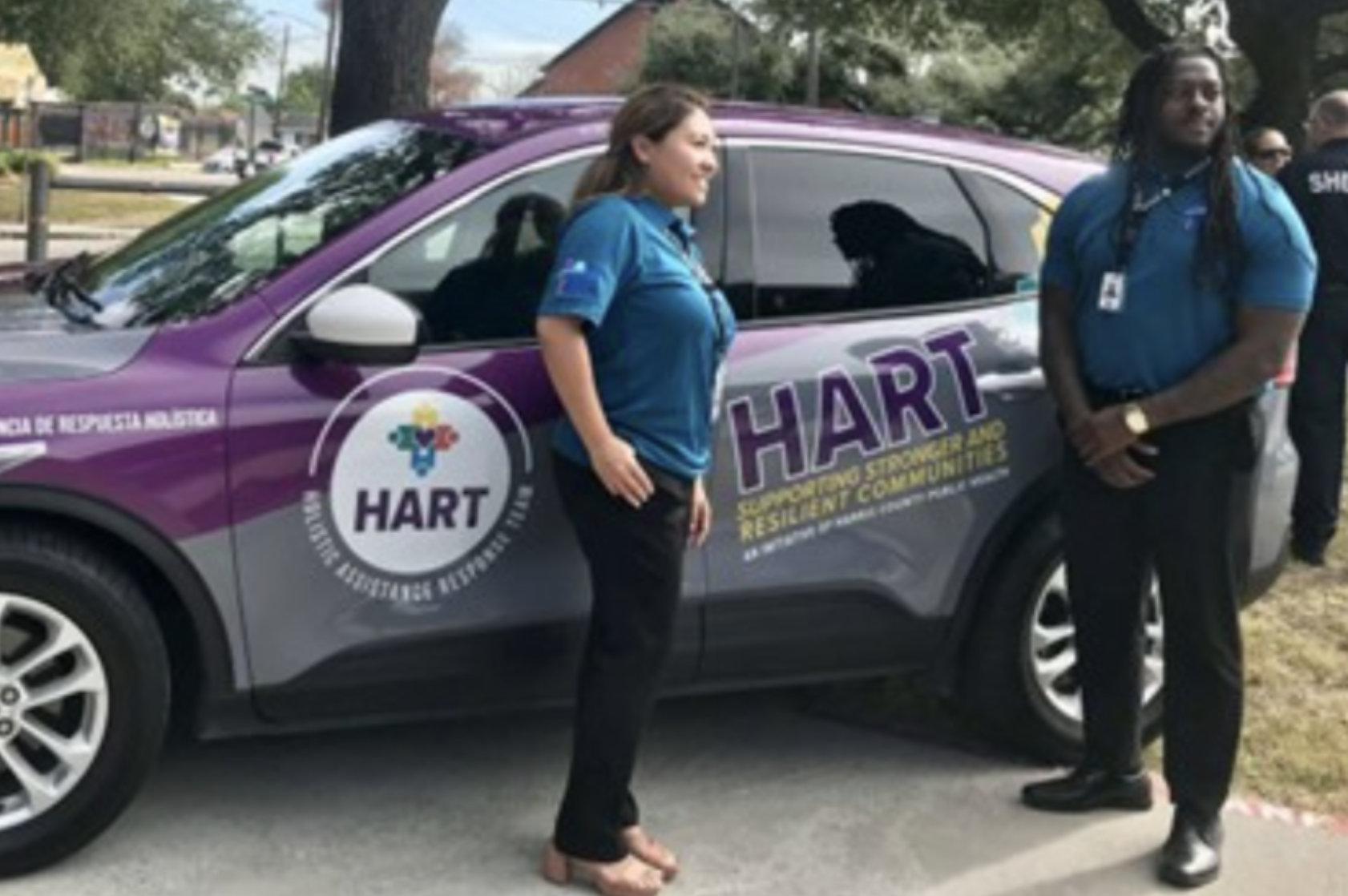
- Harris County, Texas: “A pilot program that sends public health staff instead of police to respond to certain 911 calls is expanding…” For The Houston Chronicle, Michael Murney reports that the successful Holistic Alternative Responder Team program, or HART, is getting a $2.6 million budget boost to expand its coverage area. The program, which launched last year and has already responded to nearly 2,500 calls for service, sends “interdisciplinary unarmed, first responder teams, trained in behavioral health and on-scene medical assistance” to calls for mental health-related calls. Lupe Washington, a division director with Harris County Public Health, told the Chronicle that HART “really is allowing our residents to get the help that’s needed, but also allowing our law enforcement partners to dedicate more time to the more violent calls that are going on in the community.”
- Dayton, Ohio: “Mental health crisis response team expands with $3M in grant funding.” For NBC’s local affiliate, WDTN, KaJeza Hawkins and Callie Cassick reported that new federal funding will fuel the expansion of the city’s “mobile crisis center, which sends out trained professionals to crisis situations and lowers calls to law enforcement.” Major Chris Malson with the Dayton Police Department told WDTN that he’s “grateful” for the mobile crisis program “because it gets people in distress trained mental health support.” Major Malson continued: “I think mental health workers who respond to those that are in crisis provide a better response in some situations than law enforcement or other first responders can provide.”
- Bangor, Maine: “Bangor’s new ‘human service providers …address situations that don’t require a police response.’” Writing for The Bangor Daily News, Kathleen O’Brien details the “early indicators of success” for The Bangor Community Action Team, which is the brainchild of Bangor Police Chief Mark Hathaway, who saw a need for “an alternative and more appropriate response model.” Here’s more detail on the program from the Daily News:
“The team is composed of four trained human service providers who have experience with mental health disorders, addiction recovery and veterans issues… [and] is entirely separate from the police … [The team] can help someone access medical treatment, a detox center or other recovery service, enter a shelter, get a bus ticket, or make a phone call [, and] also ensures a person’s caseworker knows where they are and what happened. The new program’s role also allows police to stop responding to calls that don’t require law enforcement, allowing them to return to their traditional role [of solving crimes.]”