There’s a growing bipartisan push to make Narcan—a life-saving drug that reverses the effects of an opioid overdose—as widely available to not only first responders, but to as many ordinary citizens as possible. To help combat the overdose crisis, leaders across the country are providing access to the easy-to-administer medication in schools and churches, bars and restaurants, in public transit stations and airlines, local vending machines and over the counter at pharmacies. Narcan has no effect when consumed by a person who is not having an overdose, meaning there is no risk in taking it. Hence, the push for widespread access.
Yet, against this backdrop of momentum, there are skeptics who argue for a more traditional law enforcement approach to opioid addiction. Here is one version of that argument against expanded availability: “Handing out like candy a drug that reverses overdoses from dangerous and illegal drugs will just make people feel more comfortable using dangerous and illegal drugs. To combat the opioid crisis, we need more police officers on the street and more arrests of illicit drug users and their dealers.”
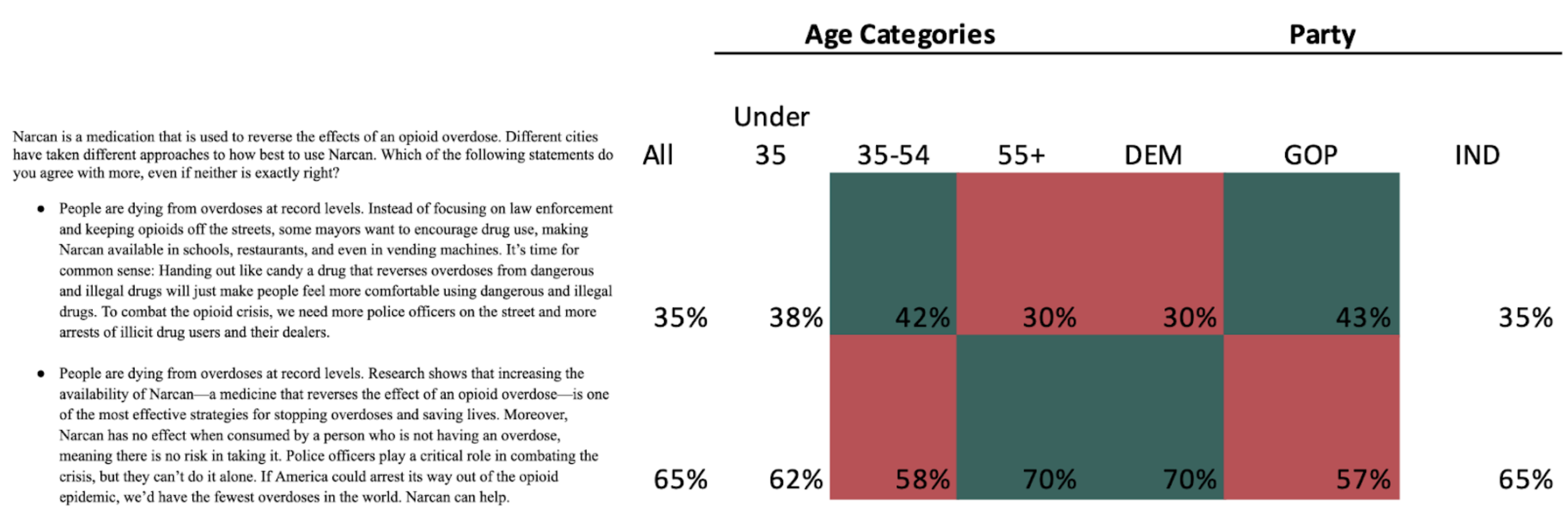
To gauge Americans’ views on the debate over increased access to Narcan, Safer Cities conducted a poll of 1,704 registered voters nationally.
After exposing respondents to strong viewpoints for and against expanding access to Narcan, we found that two-thirds of voters—including most Democrats and most Republicans—agreed more with an approach that expands Narcan access.
Related: For The New York Times, Elizabeth Spiers details the results of a survey of primary care medical residents and physician assistant trainees study which suggests that “training alone—just handling Narcan, learning how it works—was able to shift attitudes, which result[ed] in better outcomes for patients.” As Spiers explains, about one-third of the primary care providers surveyed initially disagreed with the statement: ‘I would feel comfortable having opioid-dependent patients come to my practice,’ meaning they would not feel comfortable. [However,] after Narcan training, that number fell to zero…”