- “Daniel’s Law Would Shift NY Response To Mental Crises Away From Police.” Writing for the Times-Union, Raga Justin reported on a new bill working its way through the state legislature that “would empower mental health responders, rather than police officers, to respond to distress calls and approach people experiencing a mental health or substance abuse crisis. The law aims to reshape New York’s reliance on policing during emergency calls…” The measure takes its name from Daniel Prude who “was suffering a mental health crisis when he died during an encounter with the police in Rochester three years ago, spurring waves of protests in the upstate city and calls for statewide changes to law enforcement’s approach in similar situations.”
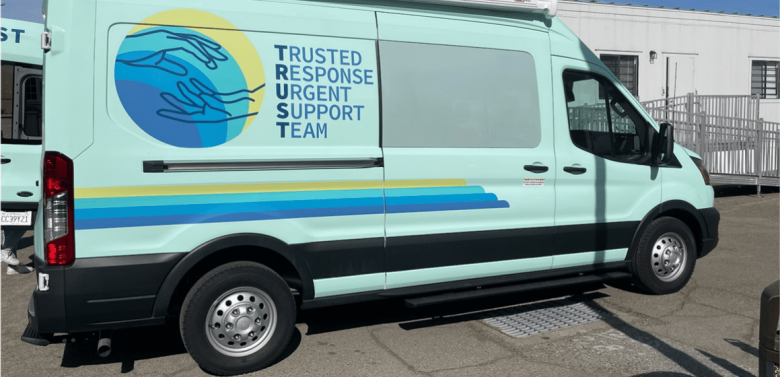
- “New program in Palo Alto, Mountain View, and Los Altos send vans with clinicians, first-aid specialists … to respond to mental health crises.” What most sets this new unarmed, crisis response team apart from the other recently formed responder teams in the region, is who the team doesn’t include: police officers, Gennady Sheyner reported for the Palo Alto Weekly. “County Supervisor Joe Simitian lauded the program for helping to “ensure the right response in a moment of crisis… obviously, when the police are needed, we want them there. But we’ve got to be smarter and more adept about getting the right kind of help to the right place in the right set of circumstances.”
- “Not every emergency requires the lights and sirens of a police car…” Reporting for the local Fox affiliate, Derek Strom reports on the launch of a new mobile crisis response team in Jackson County, Oregon, that handles mental health related calls for service:
“Before the mobile crisis response team, police would often have to respond to calls about mental health issues, which they are not trained on… [and the mobile crisis team] has a number of masters level therapists, peer support specialists and others that are better equipped to handle those situations.”
- Rick Rawlings, who oversees the mobile crisis response team, told local leaders during a recent public hearing that “one of my main goals with this is that we are able to divert calls from law enforcement [and] that we are no longer needing to have them be the only responders for individuals who are in a mental health crisis that don’t need a law enforcement response.”