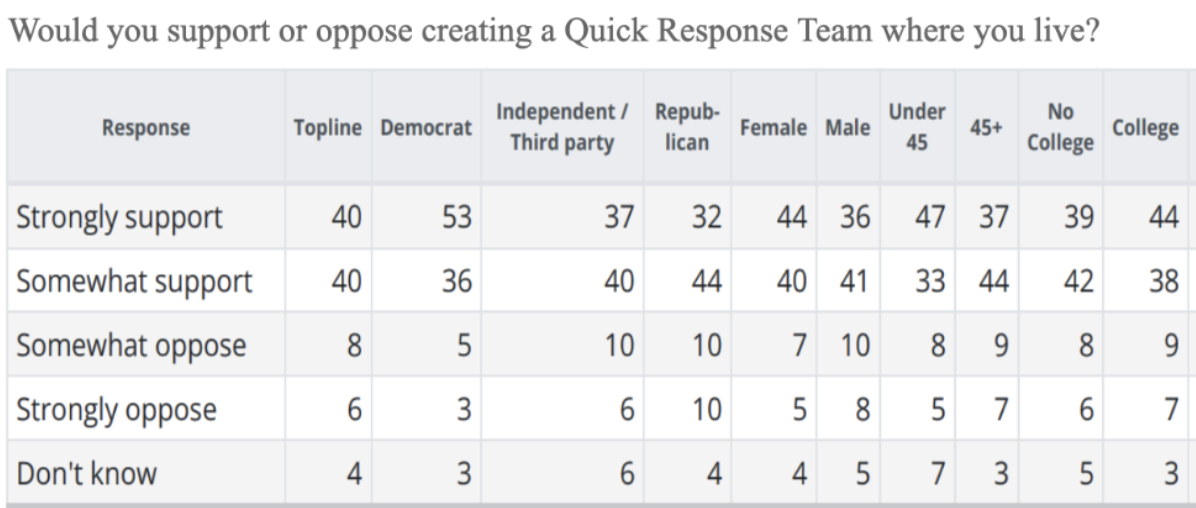
1) Our new poll finds broad bipartisan support for Quick Response Teams that deploy experts trained to prevent overdose deaths.
Earlier this year, Safer Cities covered a program out of Huntington, West Virginia that is drawing positive attention for helping to reduce opioid overdose deaths in the state with “by far the nation’s highest drug overdose death rate.” Known as the “Quick Response Team,” Huntington’s program deploys “a paramedic, a counselor, a law enforcement official, and a faith-based organization member” within 72 hours of an overdose to contact both the person involved and their family in order to monitor their health status and connect them with treatment services. Experts say that the QRT program has played a critical role in a decline in overdose deaths in the city and county.
Dr. Rahul Gupta, the director for the White House Office of National Drug Control Policy, said that the program “should be developed as a model, not just for the state of West Virginia, but for the entire country.” To gauge whether voters agree with Dr. Gupta, Safer Cities surveyed 1,249 voters nationally in partnership with Data For Progress. We found:
- 80% of voters support the creation of a Quick Response Team where they live. This robust support spans party, race, gender, age, and educational attainment.
