- Writing for the New York Times, Michael Kimmelman and Lucy Tompkins explain:
“During the last decade, Houston, the nation’s fourth most populous city, has moved more than 25,000 homeless people directly into apartments and houses. The overwhelming majority of them have remained housed after two years. Houston has gotten this far by teaming with county agencies and persuading scores of local service providers, corporations and charitable nonprofits — organizations that often bicker and compete with one another — to row in unison. Together, they’ve gone all in on “housing first,” a practice, supported by decades of research, that moves the most vulnerable people straight from the streets into apartments, not into shelters, and without first requiring them to wean themselves off drugs or complete a 12-step program or find God or a job.”
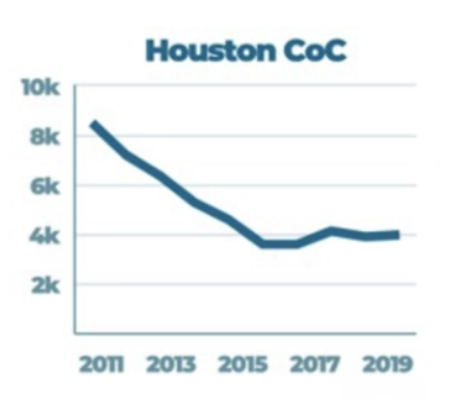
- Danielle McClean, writing for Smart Cities Dive, highlights that Houston’s housing-first approach has “decreased the area’s homeless population by roughly 63% since 2011”; a “82% reduction in family homelessness; a 69% reduction in chronic homelessness”; and “has effectively ended veteran homelessness.” Marc Eichenbaum, who heads the city’s effort, told McClean that the strategy “has quickly become a model for other cities” and that Houston officials are currently advising leaders “from Los Angeles, New York City, Chicago, Denver, Dallas, Austin, and Spokane.”
- For The Nation, Ned Resnikoff urges city leaders in California to turn to Texas for inspiration, contrasting the optimism that drove Houston’s success with the “cynicism regarding Housing First policies [in] cities [like] Los Angeles and Sacramento [that] have returned to a policing-first strategy, trying to fight homelessness by making it illegal to camp in certain areas.” Here’s an unflattering chart comparing homelessness population trends in Houston, Los Angeles, and San Francisco that Resnikoff uses to make his point:
