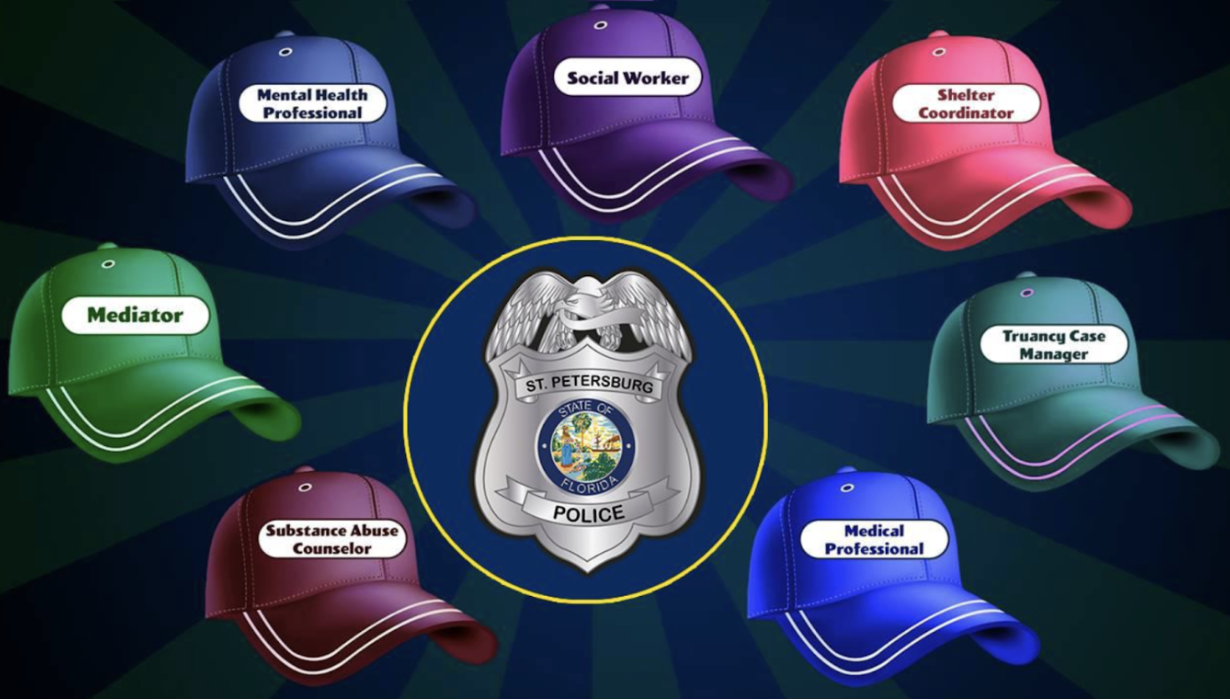
Safer Cities recently covered a mobile crisis response program in St. Petersburg, Florida called the Community Assistance and Life Liaisons (CALL), which is a joint project between the police department and Gulf Coast Jewish Family Community Services. The central premise behind CALL is that police officers are asked to wear too many hats and other experts can help share the load. The person most responsible for CALL’s creation is Megan McGee, Special Projects Manager at the St. Petersburg Police Department. She sat down with Safer Cities to discuss CALL, which recently responded to its 6,500th call—all of them with “zero incidents, injuries, or life threatening situations.” Here’s McGee in her own words:

On why a police department houses a non-police mobile crisis response team:
- “We have the perfect ingredients to fight crime and have an appropriate response to mental health situations. We can have both. [We said to officers] we are taking these kinds of calls off of your plate, it’s not that you did them wrong, but it’s what if someone else can do it better. Let’s look for someone who is better qualified to respond to these types of calls. The chief wasn’t sold on co-response [where an armed officer and a civilian handle calls together], because he said there are enough calls that are non-violent and non-criminal that we can completely divert these.”
On how police officers feel about CALL:
- “No one came to me and fought the program. This was a big win for the officers. You can hear that from the officers and the communication center folks. [And] having the top down support from the chief was huge. There were a lot of questions on safety, but there was no pushback from the officers. We have officers who are highly trained in crisis response, but they certainly could acknowledge that they were limited in what they could do with these kinds of calls. Officers shared that at certain times they felt frustrated that they were limited in what they could do [when responding to calls that involve “frequent flyers” often with underlying mental health or substance use issues that require dozens or even hundred of call responses], especially when it felt like, ‘I know I’m going to come back to that house in a month and it could be worse.’”
On how it works and is working:
- “The navigators respond in pairs. They are at least at a bachelors level [and also] there is always a clinical supervisor available as well … and the program director is also licensed … CALL never closes a client. They do as much follow-up as needed so that the client can get engaged with long term services. They do the crisis response, then do follow up, and longer term follow up, they are excellent about that … And 95% of their calls happen without law enforcement engagement, and interestingly, the most common reason they request law enforcement is when it’s a mental health transport [and] it’s literally just assisting them in the transport.”
On one example of CALL’s impact:
“A teenager and mother [were] having an ongoing conflict in the home which produced several 911 calls daily due to the child’s behavior. Behavior would include breaking windows in the home, breaking car windows, running away and being rough with other children in the home. Law enforcement asked for CALL’s aid in connecting the family with services to reduce and prevent police interaction. After working with the family for several months and connecting not only the juvenile, but her mother, to various in-home supports, the child is now employed part-time, attending school, getting excellent grades, and there have been no calls for service at that residence since.”