For Governing, Jared Brey reports on Minneapolis’s new Transit Rider Investment Program, or TRIP, an “ambassador-style [team] to help improve the transit experience [that will] check fares, enforce codes of conduct and help connect people experiencing homelessness and addiction with social services agencies.” A recent presentation from city officials gave a helpful look at where residents want the teams deployed and what their core duties will be:

- Minneapolis is just the latest city to establish a Transit Security Ambassador team:
- In Los Angeles, California the Metro Transit Ambassador Program placed 300 unarmed, uniformed transit ambassadors to watch over the county’s trains and buses to “create a culture in which the ambassadors [act as] the front line, managing the lion’s share of incidents in transit [and] reserve law enforcement and armed responses to those incidents that truly warrant it.”
- In Cleveland, Ohio the Greater Cleveland Regional Transit Authority launched its unarmed “highly visible, uniformed civilian force created with the goal of preventing violence and disruptive behavior, providing assistance during medical emergencies and maintaining a vigilant watch over rail stations, transit centers and bus lines … [The] team includes crisis intervention specialists who are trained and have expertise in using conflict resolution skills to help people experiencing mental health crises.”
- In Washington D.C., the Metro Ambassadors “tamp down on crime spikes [and] boost security without hiring or deploying more police officers.” D.C. Metro’s General Manager Randy Clarke said the ambassadors help to “provide great service [and are] another additive layer to make sure we have more visibility for safety, security and more thinking about the customer in everything we do.”
- Transit Security Ambassadors Are Likely To Deter Crime Due To The Sentinel Effect. Lesley Kandaras, Metro Transit’s general manager, lauded the creation of the Transit Safety Ambassadors as “an opportunity to increase official presence on our system, to add more eyes and ears.” That’s the same sentiment that the director of a similar program—Deputy Chief Angela Averiett, who oversees the public transportation ambassador program for Bay Area Rapid Transit—recently expressed “just them being in a train may stop someone from smoking crack or from defecating in a train car…I think it really makes people kind of think twice before they do something that’s illegal or harmful to themselves or others.” What these leaders are expressing is known as the sentinel effect—clearly visible eyes and ears make crime less attractive—is more important than even the power of apprehension. There is a solid body of evidence for the sentinel effect, and the theory that cities are putting into practice is that security ambassadors can serve this role.
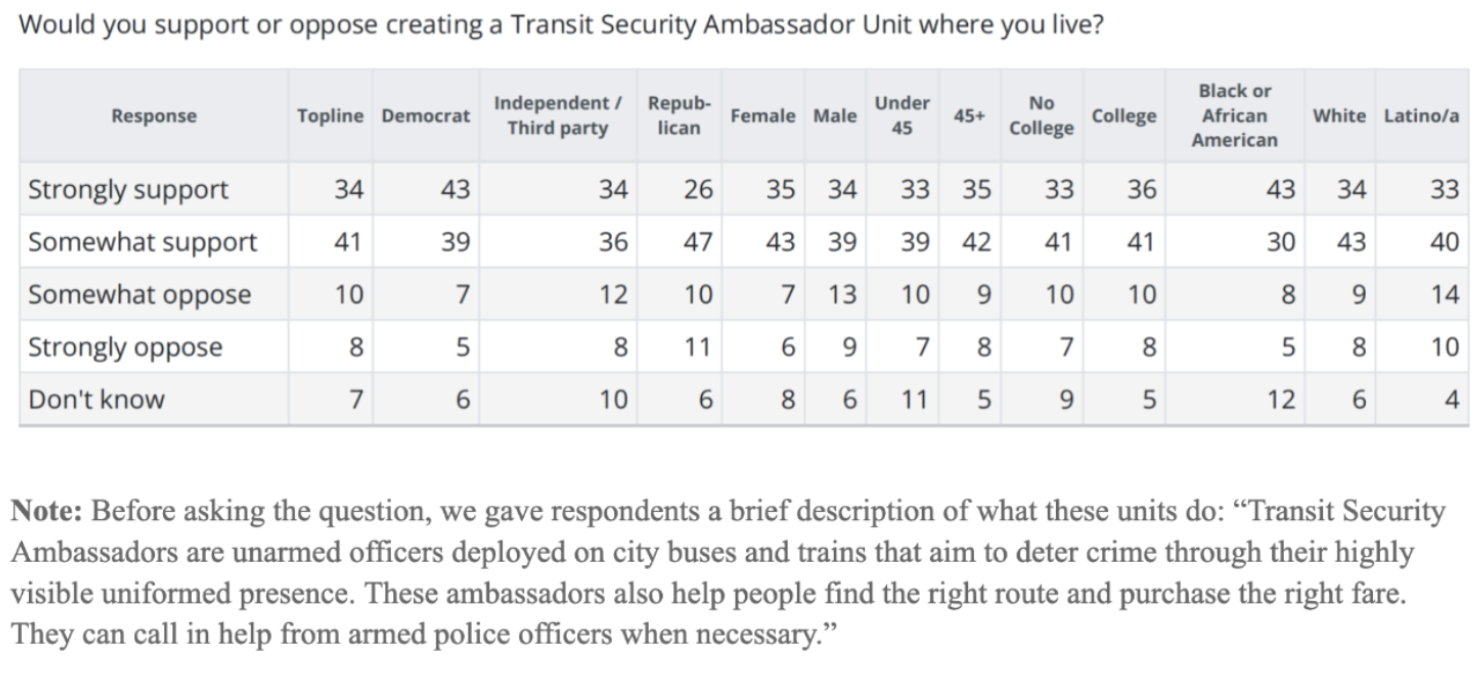
- Transit Security Ambassador teams enjoy robust public support. A recent Safer Cities poll found 75% of voters support “the creation of an unarmed transit security ambassador unit where they live.”